
22 Sep Walking Pads for Small Offices: 5 Space-Saving Setups
See how compact walking pads fit into small offices without sacrificing desk space, comfort, workflow, or the quiet environment people need to work.
A small office has one unforgiving rule: every square foot has a job.
That makes the growing popularity of walking pads interesting. Instead of adding a large treadmill to an office, people are putting slim walking platforms under standing desks, beside workstations, or in corners that would otherwise sit unused.
The idea is simple. Walk slowly while answering emails, reading documents, joining a meeting, or listening to a presentation.
But the real challenge is not buying a walking pad. It is designing the office around it without creating a cramped, noisy, awkward workspace.
That matters more in 2026 because small offices, home offices, hybrid workspaces, and shared work areas are increasingly expected to do more with less floor space. Recent discussions on Reddit show the same practical concerns appearing again and again: noise, storage, desk height, floor vibration, and whether people will actually use the equipment consistently.
Here are five ways to think about a walking pad in a small office.
Key Facts at a Glance
- Compact under-desk treadmills commonly measure about 50–60 inches long and 20–24 inches wide.
- A conventional home treadmill can be roughly 70–80 inches long and 28–34 inches wide, making it much harder to integrate into a small workspace.
- Workplace research has found that treadmill-desk interventions can increase workplace stepping and reduce some sedentary behavior.
- Research does not show that a walking pad automatically solves sedentary behavior for everyone. Long-term results vary by setup and behavior.
- Reddit users frequently mention noise, vibration, storage, desk height, and the hassle of moving the pad as practical issues.
- Good workstation design still matters. OSHA recommends adequate leg clearance and a neutral working position rather than simply adding movement underneath a poorly configured desk.
What Is a Walking Pad?
A walking pad is essentially a compact treadmill designed primarily for walking.
Unlike a traditional treadmill, many walking pads remove the large front console and handrail. The result is a lower-profile machine that can slide underneath a standing desk when it is not being used.
That difference is important in a small office.
A traditional treadmill can dominate the room. A walking pad can become part of the workstation instead.
Compact and under-desk treadmills generally fall around 50–60 inches long and 20–24 inches wide, although dimensions vary considerably by model.
That still sounds large until you compare it with a conventional home treadmill.
A typical full-size home treadmill can reach 70–80 inches in length and 28–34 inches in width.
The walking pad is therefore not necessarily “tiny.” Its advantage is that its footprint is designed around a different use case.
It is less about running and more about adding low-intensity movement to a workstation.
Why Walking Pads Matter in Small Offices
The modern office creates an unusual problem.
You can spend hours moving only between a desk, a coffee machine, and the bathroom. Even people who exercise regularly outside work can spend much of their working day sitting.
Research has explored whether active workstations can change that pattern.
One randomized workplace study involving 41 office workers found that the treadmill-desk group increased daily steps by about 1,622 steps per day compared with the control group and also reduced sedentary time during working hours.
A broader network meta-analysis covering 23 randomized controlled trials and 1,428 office workers found that treadmill workstations combined with behavior-promotion strategies were associated with reductions in occupational sedentary time. The researchers also emphasized that the certainty of evidence was low.
That last point matters.
A walking pad is not a magic health device.
It is better understood as a tool for changing the physical pattern of a workday.
Movement without leaving the desk
This is the strongest argument for the concept.
Instead of deciding, “I need to find 30 minutes to exercise,” the office can create opportunities for small amounts of movement during activities that are already happening.
That might mean walking during:
- Internal meetings where you do not need to present
- Podcasts or training sessions
- Long reading sessions
- Routine email work
- Calendar and administrative tasks
- Video meetings where movement will not interfere with participation
Research also suggests that the type of active workstation matters. A 12-month randomized study found that treadmill-desk users increased workplace stepping in the short term, while sit-to-stand desks encouraged more frequent transitions between sitting and standing.
In other words, movement does not have to mean walking all day.
The best office may simply make different positions easier.
5 Space-Saving Walking Pad Setups
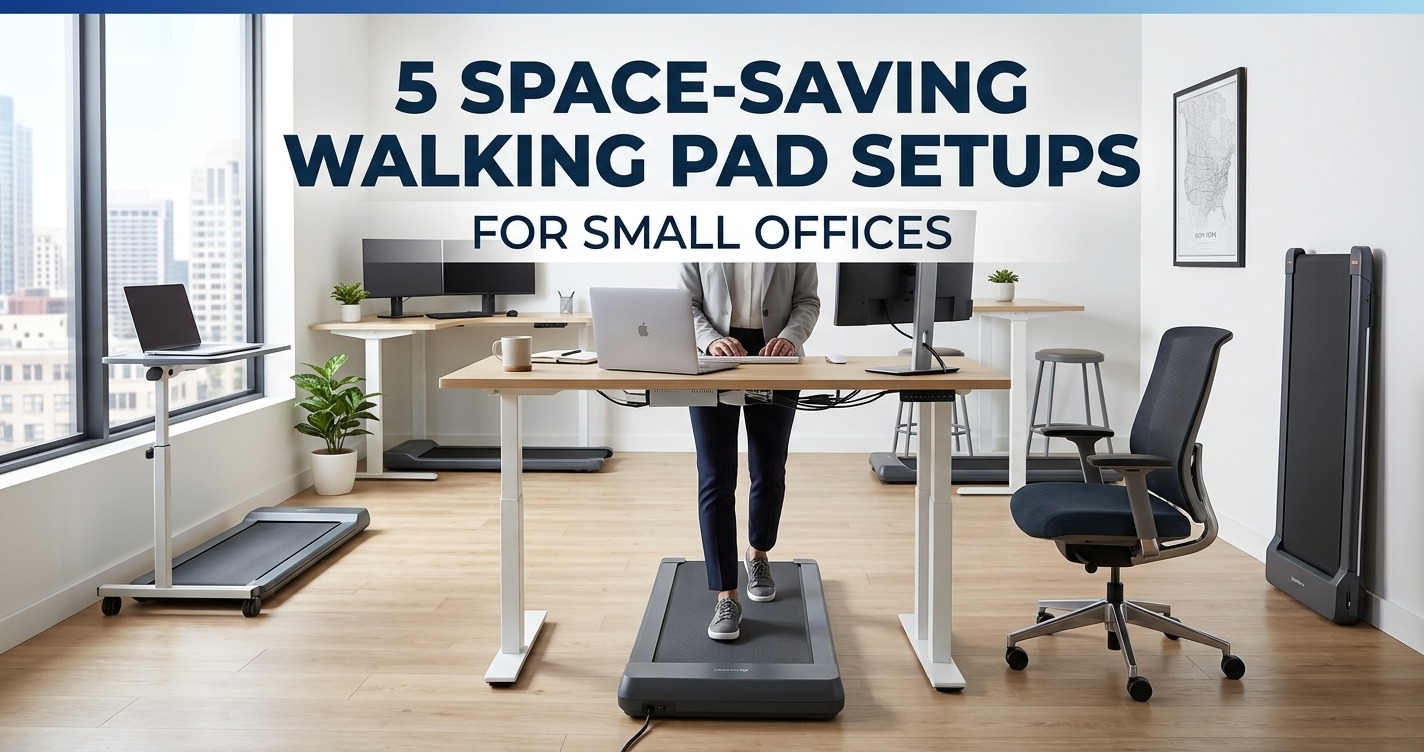
1. The Under-Desk Slide-In Setup
This is the most obvious configuration.
The walking pad stays directly underneath a height-adjustable standing desk. When you want to walk, you move the chair away and step onto the pad.
When you want to sit, the chair returns.
Why it works
The same floor area serves two purposes.
You do not need a dedicated cardio corner, which is valuable in an office measuring only a few dozen square feet.
The catch
The desk needs enough height adjustment to accommodate the walking surface.
A common mistake is thinking only about the pad’s dimensions. The desk, chair, monitor, keyboard, cables, and leg clearance all matter too.
OSHA specifically warns that inadequate space beneath a workstation can restrict movement and contribute to awkward working positions.
Best principle: design the desk and walking surface as one workstation rather than treating the walking pad as an accessory.
2. The Rolling Desk Setup
Instead of pushing the walking pad underneath a fixed desk, use a mobile standing desk or rolling workstation.
The walking pad remains in a dedicated spot while the desk can move over it.
This sounds like a small distinction, but it changes the workflow.
A Reddit user describing a walking-pad office setup said a separate area with a rolling standing desk and portable second monitor made the equipment substantially easier to use because they no longer had to repeatedly rearrange the main desk.
Why it works
The walking zone becomes a second work position.
You can have:
Sitting desk → standing desk → walking workstation
without forcing one piece of furniture to perform every job.
The trade-off
It uses more dedicated floor area.
But sometimes dedicated space creates better space efficiency in practice because you stop constantly moving furniture.
3. The Corner Storage Setup
For very small offices, the biggest problem may not be walking.
It may be where the walking pad goes when nobody is using it.
This is where a vertical or corner-storage strategy becomes useful.
A compact walking pad can occupy a narrow wall zone when stored, depending on its design and manufacturer instructions.
The key is to keep the storage location close to the workstation.
Why?
Because every extra step in the setup process creates friction.
Reddit discussions repeatedly show this issue. Users describe machines that become less attractive when they have to be unfolded, moved, positioned, and connected every time.
The lesson is surprisingly simple:
The easiest walking pad to use is often the one that does not require a major setup ritual.
4. The Shared Office Walking Station
A small office does not necessarily need one walking pad per person.
A shared workstation can create a dedicated movement zone.
Imagine a compact corner with:
- One walking pad
- One height-adjustable desk
- One monitor
- Wireless keyboard and mouse
- A small storage area
- A floor mat
Employees can use the station for low-focus tasks or meetings where walking is appropriate.
This approach also changes the economics of floor space.
Instead of giving every desk a walking pad, one movement station serves several people.
The downside is availability. If everyone wants to use it at the same time, the space becomes a scheduling problem.
Still, for a small office, that may be easier to solve than finding room for multiple treadmills.
5. The Dual-Purpose Meeting Setup
This is the most interesting configuration.
Rather than thinking of the walking pad as a personal fitness machine, treat it as part of a flexible meeting area.
A small walking station can sit beside a standing meeting surface.
One person can walk while participating in an audio-heavy meeting, training session, or internal discussion.
The rest of the room remains available for normal office use.
This setup works particularly well when the office already has flexible furniture.
It also reflects a broader workplace principle: movement becomes easier when the environment supports multiple working positions rather than forcing everyone into a chair.
Walking Pad vs. Other Small-Office Options
The important comparison is not “Which treadmill is best?”
It is which type of movement setup makes sense for the available space and work style?
| Setup | Typical Footprint | Storage Need | Movement Added | Main Trade-Off |
|---|---|---|---|---|
| Walking pad + standing desk | About 50–60 × 20–24 in | Low if left under desk | Walking | Desk height and noise need attention |
| Full-size treadmill | About 70–80 × 28–34 in | High | Walking/running | Large footprint for office use |
| Sit-stand desk | Desk footprint only | Very low | Standing | Does not add walking |
| Shared walking station | About 50–60 × 20–24 in + desk clearance | Moderate | Walking for multiple users | Requires shared scheduling |
| Walking pad + rolling desk | Pad footprint + mobile desk | Moderate | Walking + standing | Uses a dedicated movement zone |
Mobile reading tip: on a phone, the table above is designed to scroll horizontally. Hold the table area and swipe left or right to see the remaining columns.
The walking-pad dimensions above reflect the compact/under-desk category rather than a specific product. Full-size treadmill dimensions are based on published industry ranges.
The Problem Nobody Talks About Enough: Noise
A walking pad can be compact without being silent.
That distinction matters enormously in an office.
Recent Reddit discussions from people specifically looking for office walking pads repeatedly focus on noise because motor sound, belt movement, and foot impact can interfere with coworkers or video calls.
There is also a difference between airborne noise and vibration.
Someone in a private office may barely notice motor noise. A person on another floor may notice repetitive impact through the building structure.
One apartment discussion described significant footfall and vibration from an upstairs walking pad, while other users reported much better results after adding mats or vibration-absorbing material.
So the practical rule is:
Do not evaluate office noise only by listening beside the machine.
Think about:
- The floor construction
- Nearby desks
- Meeting rooms
- Shared walls
- Calls and microphones
- The time of day
- Footfall as well as motor noise
A floor mat can help, but it does not make every setup silent.
Ergonomics Still Come First
Adding a walking pad does not automatically create an ergonomic workstation.
In fact, it can create new problems if the desk is too low, the monitor is poorly positioned, or the keyboard forces the user to reach.
OSHA recommends keeping the head level, shoulders relaxed, elbows close to the body, and wrists and forearms in a neutral position.
That means the correct question is not:
“Can this desk fit over the walking pad?”
It is:
“Can I maintain a comfortable working position while the walking surface is underneath me?”
That difference is huge.
A good small-office setup should allow the user to switch between sitting, standing, and walking without turning the workstation into a puzzle.
What Reddit Users Are Getting Right
Online discussions are not scientific evidence, but they are useful for identifying the problems people encounter in real environments.
Three themes appear repeatedly.
1. Noise is personal
Some users describe their walking pads as barely noticeable. Others worry about coworkers, neighbors, or people below them.
There is no universal “quiet enough.”
2. Storage changes usage
Several discussions point to the same behavioral problem: if using the walking pad requires moving furniture every time, people may use it less.
That is an important design lesson.
3. Slow walking is the natural office use case
Users commonly describe walking during meetings, webinars, or low-focus work rather than trying to maintain fast walking while performing demanding tasks.
That aligns with the purpose of the workstation.
The office walking pad is not really replacing a gym treadmill.
It is changing what happens during the hours you already spend at your desk.
What the Research Means for the Reader
The research gives a more balanced picture than the marketing around active workstations sometimes suggests.
Treadmill desks can increase movement.
A meta-analysis of 13 studies involving 351 participants found that treadmill-desk use increased measured energy expenditure in laboratory settings and reduced sitting time in workplace studies. However, the authors found no clear evidence of improvements in several other metabolic outcomes and called for more research.
Another 12-month study found that total daily sedentary time did not significantly differ between groups after a year, even though treadmill users showed short-term increases in workplace stepping.
So the useful takeaway is not “walking pads are the solution.”
It is this:
A walking pad can make movement more convenient, but the office environment still determines whether that convenience becomes a habit.
How This Changes Small Offices in 2026
The bigger trend is not really about treadmills.
It is about flexible workstations.
A modern small office can no longer assume that one desk and one chair should handle every task.
The same principle appears in small home-gym design: limited square footage rewards equipment and furniture that serve multiple purposes rather than simply adding more things. Gym Equipage’s existing coverage of cardio layouts and compact equipment follows this same space-efficiency idea.
For readers building a small office, the useful question is therefore:
What can this square foot do when I am not sitting?
That could mean walking.
It could mean standing.
It could mean stretching during a break.
Or it could simply mean leaving enough clear floor space to change position comfortably.
What to Consider Before Building the Setup
Before putting a walking pad into a small office, measure more than the machine.
Check:
- Walking pad length and width
- Desk height range
- Monitor height
- Keyboard and mouse position
- Chair clearance
- Walking clearance
- Storage location
- Cable routing
- Door and hallway access
- Floor type
- Noise and vibration
- Whether coworkers need to pass through the area
The goal is not to squeeze one more piece of equipment into the office.
The goal is to make movement fit naturally into the room.
Conclusion: Space Efficiency Beats Equipment Hype
Walking pads make sense in small offices for one simple reason: they can turn an existing workstation into a movement-friendly space without requiring the footprint of a conventional treadmill.
But the machine itself is only half the story.
Desk height, floor clearance, storage, noise, vibration, and everyday convenience matter just as much as the walking surface.
The smartest small-office setup is not necessarily the one with the smallest walking pad. It is the one that makes sitting, standing, walking, and switching between them feel easy.
That is the real space-saving idea for 2026: do more with the same floor area instead of simply adding more equipment.