
11 Sep Home Gym Storage Ideas: Chain Hangers, Racks & Organization That Works
Home Gym Storage Ideas That Actually Work (Chain Hangers, Racks, and Smarter Organization)
You finally carved out space for a home gym. Then, about three weeks in, it started looking like a garage sale. Dumbbells under the couch, resistance bands tangled in a drawer, a yoga mat rolled up in the corner collecting dust bunnies. Sound familiar?
Storing gym equipment at home is one of those problems nobody thinks about until it’s already a mess. You buy the equipment, you get excited about the workouts, and storage becomes an afterthought — right up until you trip over a kettlebell in the dark or give up on your morning routine because digging out your gear takes longer than the workout itself.
This guide walks through real storage systems that hold up over time, not just for a photogenic first week. That includes chain hangers, which are one of the simplest and most overlooked tools for hanging heavier gear off the floor. You’ll also find ideas for closets, garages, small apartments, and everything in between, plus a few honest opinions about what’s worth buying and what you can skip.
Why Gym Equipment Storage Is Worth Solving Early
A cluttered workout space does more than look bad. It’s a safety issue — stray dumbbells and tripped-over yoga blocks cause real injuries, especially if you’re moving fast between sets or working out in low light before the sun comes up. Clutter also kills motivation. If your equipment isn’t visible and easy to grab, you’re less likely to use it, and a home gym you don’t use is just an expensive storage problem in itself.
There’s also a practical space argument. Most home gyms live in shared areas: a corner of the garage, a spare bedroom, a basement that doubles as a playroom. Good storage means the space can go back to being a garage, bedroom, or playroom in minutes, instead of staying permanently off-limits to the rest of the household.
Take Stock Before You Buy Any Storage System
It’s tempting to jump straight to Pinterest boards full of beautiful garage gyms. But the right storage setup depends entirely on what you own and how much of it there is. Before buying anything, sort your equipment into a few rough categories:
- Heavy, awkward items — barbells, weight plates, kettlebells, dumbbells
- Small daily-use items — resistance bands, jump ropes, ab wheels, gloves
- Flat or rollable items — yoga mats, foam rollers, sliders
- Machines — treadmills, bikes, rowers, benches, power racks
Each category needs a different storage approach. Trying to force everything into one shelving unit is usually how people end up with the chaotic pile they started with, just now sitting on a shelf instead of the floor.
Gym Closet Organization for Small Spaces
If your home gym lives in or near a closet, you’ve actually got an advantage — closets are enclosed, out of sight, and easy to childproof. The trick is treating it less like a closet and more like a mini equipment room.
Vertical space is your best friend here. Most closets waste the upper third of their height on empty air, so a few tiers of adjustable shelving can hold folded resistance bands, rolled mats, and smaller accessories without eating floor space. Over-the-door organizers work well for lighter gear like jump ropes, gloves, and ankle weights. For anything heavier, skip flimsy wire shelving — it sags under weight plates and dumbbells faster than you’d expect, and a sagging shelf is its own safety hazard.
A slim rolling cart is worth considering if your closet doubles as storage for non-gym items. You can wheel the whole thing out when you’re working out and tuck it back in when you’re done, which keeps the closet functional for its other job too.
Turning a Garage Corner Into a Real Workout Space
Garages are the most popular home gym location for a reason: concrete floors, decent ceiling height, and enough room to swing a kettlebell without knocking over a lamp. The catch is that garages also store the lawn mower, holiday decorations, and whatever else doesn’t fit in the house, so equipment tends to get buried or pushed aside.
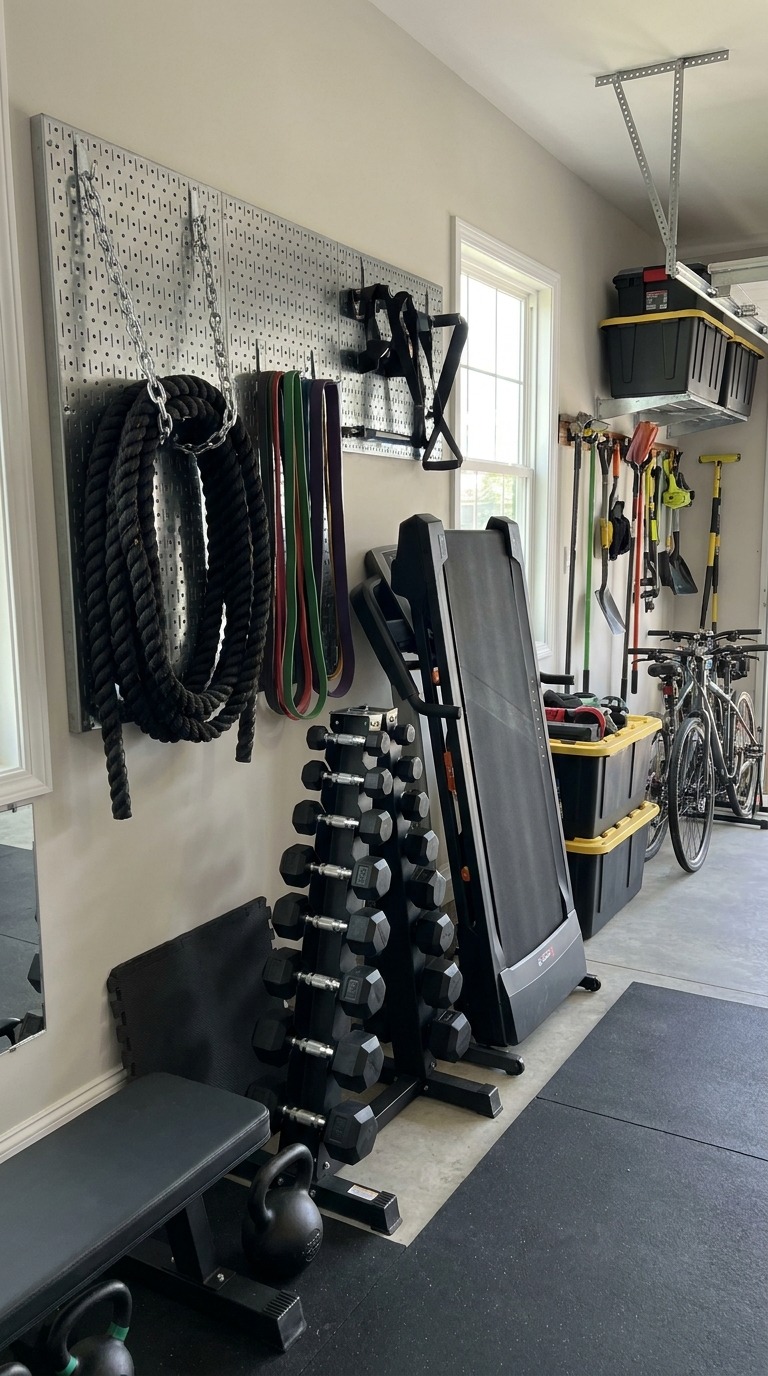
Wall-mounted storage solves most of this. A slat wall or pegboard system near your workout zone lets you hang resistance bands, jump ropes, and lighter accessories at eye level, which means you’ll actually see and use them. For bigger equipment, a dedicated shelving unit against one wall keeps weight plates and dumbbells organized by size, so you’re not hunting through a pile every time you want to change your load.
If you’re planning your garage gym layout from scratch, it helps to map out where cardio equipment, strength gear, and storage will each live before you start bolting things to the wall. This garage layout guide for placing cardio machines is a useful reference for figuring out where treadmills, bikes, and rowers should sit relative to your storage zones, especially if you’re working with a single-car garage where every foot matters.
One thing worth saying clearly: garages get hot in summer and cold in winter, and both extremes are hard on rubber grips, resistance bands, and foam. If your garage isn’t insulated, storing sensitive gear in a closed cabinet rather than leaving it out on open shelving will noticeably extend its life.
Chain Hangers: The Storage Trick Most People Skip
Chain hangers don’t get talked about much outside of commercial gyms, but they solve a specific problem that shelving and racks can’t: getting heavy, bulky items completely off the floor and out of the way without needing a huge footprint.
A chain hanger is exactly what it sounds like — a length of heavy-duty chain, usually anchored to a wall stud or ceiling joist, with hooks or loops spaced along it. You hang items directly onto the chain instead of setting them on a shelf. It’s a favorite for battle ropes, heavy resistance bands, TRX straps, and even some smaller kettlebells, because the chain holds the shape of the item instead of letting it flop or tangle.
Why chain hangers work better than you’d expect:
- They use vertical wall space that would otherwise sit empty
- There’s no shelf lip or ledge for dust and grime to build up on
- Heavy or awkward items (like coiled ropes) actually hang cleanly instead of sliding around
- Installation is usually just a couple of screws into a stud, no assembly required
Where chain hangers fall short:
- They’re not ideal for anything with a flat base, like a yoga mat or foam roller
- Poorly anchored chains can pull out of drywall, so studs or proper wall anchors are non-negotiable
- They work best against a wall you don’t need for anything else — mirrors, pegboards, and racks all want that same real estate
If you’re weighing chain hangers against a wall-mounted rack system, it doesn’t have to be either-or. A lot of well-organized garage gyms use chain hangers for the odd-shaped, rope-like items and reserve shelving or a proper rack for anything with a flat bottom, like plates or a foam roller. Think of chain hangers as filling the gap that traditional shelving leaves open, rather than replacing it entirely.
Weight Storage Ideas That Don’t Wreck Your Floors
Weights are usually the heaviest, most damage-prone part of any home gym, and they deserve their own storage plan rather than an afterthought pile in the corner.
A vertical dumbbell rack is one of the most space-efficient options if you’re working with a smaller set — it stores dumbbells standing up rather than laid flat, which cuts the footprint significantly. For a growing collection, a tiered A-frame rack keeps everything visible and graded by weight, so you’re not squinting at tiny numbers stamped on the side of each dumbbell mid-workout.
Weight plates are a slightly different problem. A vertical plate tree keeps plates upright and sorted by size, which protects both your floor and the plates themselves — stacking plates flat on concrete tends to chip the edges over time, especially with bumper plates. If you’re just starting to build a free-weight collection and want guidance on which pieces to prioritize before you’re stuck storing gear you barely use, it’s worth reading up on putting together a free-weight routine designed around what women actually need from a home setup — it’ll help you buy with intention instead of accumulating dumbbells you never touch.
A cheap trick that gets overlooked: rubber floor mats under any weight storage area. They protect concrete or hardwood from dents and scratches, and they quiet the inevitable clank when you’re loading or unloading plates.
Storage Ideas for the Rest of Your Sport Equipment
Not everything in a home gym is heavy. Resistance bands, sliders, foam rollers, medicine balls, and jump ropes are light but somehow always end up as the most scattered items in the room.
A few approaches that hold up:
| Storage Method | Best For | Watch Out For |
|---|---|---|
| Wall hooks or pegboard | Bands, ropes, gloves | Overloading hooks meant for light items |
| Bin or basket system | Balls, sliders, small accessories | Bins becoming a junk-drawer catch-all |
| Rolled mat holder | Yoga and exercise mats | Cheap holders that don’t grip properly |
| Chain hanger | Battle ropes, coiled bands | Not suited to flat-bottomed items |
Labeling bins sounds almost too simple to mention, but it’s genuinely one of the fastest ways to keep a shared family space usable. If everyone knows the blue bin is for bands and the gray one is for balls, gear actually goes back where it belongs instead of piling up wherever it was last used.
Mini Gym at Home: Storage for Tiny Spaces
Not everyone has a garage or a spare room. A lot of home gyms live in a corner of a bedroom, a hallway nook, or a slice of a living room — and that’s genuinely fine, as long as the storage plan matches the scale of the space.
For a true mini setup, multi-use furniture does a lot of heavy lifting. A storage ottoman can double as a seat and a home for resistance bands and light dumbbells. A slim bookshelf-style unit against an unused wall holds more than it looks like it should, especially if you’re using stackable bins instead of loose items.
The other trick that works well in small spaces: fold-and-store equipment. A foldable bench, a collapsible step platform, or resistance bands that roll into a small pouch all give you the same workout options without the permanent floor footprint. If you’re outfitting a whole compact setup and want it to work within a tight budget and space, browsing a full breakdown of all-in-one gym machines built for different room sizes and budgets is a good next step — a single well-chosen machine can replace several separate pieces of equipment, which is often the real solution to a small-space storage problem.
Wall-Mounted Organizers vs. Freestanding Racks
This comes up constantly, and the honest answer is: it depends on your walls and your landlord.
Wall-mounted organizers — pegboards, slat walls, chain hangers, hook systems — are more space-efficient and generally cheaper. They also require drilling into studs, which isn’t always an option if you’re renting or dealing with finished drywall without easy stud access.
Freestanding racks and shelving units cost more and take up floor space, but they’re fully portable. You can rearrange them, take them with you if you move, and skip any wall damage. They’re also usually the safer bet for heavier weight storage, since a poorly anchored wall unit loaded with plates is a real hazard.
A reasonable middle ground: use wall-mounted storage for lighter items (bands, ropes, gloves, jump ropes) and freestanding units for anything with real weight behind it. That split plays to the strengths of each system instead of forcing one solution to do everything.
Storing Cardio Machines Without Losing the Room
Treadmills, bikes, and rowers are the biggest storage headache in most home gyms simply because of their size. A few genuinely help here:
- Choose equipment that folds. This sounds obvious, but plenty of people buy the non-folding version of a treadmill or bike because it’s slightly cheaper, then regret it the first time they need the room back for something else.
- Use furniture sliders or a rolling base. Even bulky machines become manageable when you can slide or wheel them against a wall after a workout instead of muscling them around.
- Plan your layout before buying, not after. Measuring your available floor space and mapping where each machine will live — including how much clearance it needs when folded versus in use — prevents the common mistake of buying a machine that technically fits but blocks the door when it’s stored.
If a treadmill is on your list and floor space is tight, it’s worth specifically looking for a model built with storage in mind rather than retrofitting a bulky one into your routine. The NordicTrack T Series folding treadmill is a solid example of this approach — it’s designed to fold up vertically, which shrinks its footprint dramatically compared to leaving a full-size treadmill deployed at all times.
What makes it worth considering, storage-wise:
- The folding deck means it can be tucked against a wall or into a closet corner between sessions, instead of permanently occupying the center of a room
- Built-in wheels on most NordicTrack folding models make it realistic to move on your own, without needing help every time you want to store it
- It’s a full-size running deck when unfolded, so you’re not sacrificing workout quality for the sake of a smaller storage profile
Where it’s less of a fit: if you’re extremely tight on space even when folded, or if you’re specifically after the slimmest possible profile (like a true under-desk walking pad), a compact walking pad will store flatter and take up less depth than a folding treadmill, even though it trades away some of the running-speed capability. It’s also worth factoring in that any folding treadmill still needs enough clear floor space to fold and unfold safely — measure that swing radius before you commit, not after delivery.
Keeping the System Working Six Months From Now
The best storage setup in the world falls apart if it’s not part of your actual routine. A few habits make the difference between a gym that stays organized and one that slides back into chaos:
- Put gear away at the end of each session, not “later.” Later rarely comes, and clutter compounds fast.
- Reassess every few months. Equipment you don’t use anymore is taking up space that something you do use could occupy.
- Keep a small maintenance kit nearby — a rag, some grip tape, maybe a multitool — so quick fixes happen on the spot instead of turning into a pile of “I’ll deal with this eventually” gear.
None of this needs to be complicated. The goal is a system simple enough that putting things away takes less effort than leaving them out, because that’s really the only test that matters for whether a storage system sticks.
Frequently Asked Questions
Are chain hangers strong enough for heavier gym equipment? It depends on the chain gauge and how it’s anchored. A properly rated chain secured into a wall stud or ceiling joist can hold significant weight, but always check the chain’s weight rating and anchor into solid framing — not just drywall — for anything heavier than light accessories.
What’s the cheapest way to organize a small home gym? Bins, over-the-door organizers, and a few wall hooks cover most small-space needs without much cost. The biggest “free” upgrade is simply sorting equipment by category before buying any storage products, so you’re not guessing at what you actually need.
Should I store weight plates vertically or stacked flat? Vertical, when possible. Stacking plates flat on the floor is harder on both the plates and the flooring underneath, and it makes it harder to grab a specific weight without moving several others out of the way first.
Can I use chain hangers in an apartment? Only with landlord approval for wall anchoring, and only into studs — never just drywall anchors for anything with real weight. If drilling isn’t an option, a freestanding rack or over-the-door system is the safer route.
How much space does a home gym storage system actually need? Less than most people assume. A single wall (roughly 4–6 feet) with a mix of shelving, hooks, and a chain hanger or two can organize a surprising amount of equipment, especially once heavier items are stored vertically instead of laid flat.
Do folding treadmills save meaningful space compared to non-folding ones? Yes, usually a significant amount. A folded treadmill typically reduces its footprint by roughly half compared to a non-folding version, which matters a lot in a shared room or garage that needs to serve other purposes.
What’s the biggest mistake people make with home gym storage? Buying storage furniture before sorting what they actually own. It leads to mismatched systems — shelving that’s wrong for the weight, hooks rated for the wrong load, bins too small for what needs to go in them.