
20 Jul At-Home Gym Equipment for Women: Simple, Budget-Friendly Setup Guide
At-Home Gym Equipment for Women: How to Build a Space That Actually Gets Used
You know that moment, somewhere around month three of a gym membership, when you start doing the math on gas money and parking and the fifteen minutes you spend just waiting for the squat rack? That’s usually when the idea creeps in. A little corner. Some equipment. No commute, no crowded weight floor, no guy who wants to “fix your form” without being asked.
Here’s the thing nobody tells you: building a home gym is way less complicated than it looks on Instagram. Most of what actually matters fits in a closet. This guide covers what’s worth buying, what you can skip entirely, and how to put together a setup that sculpts, tones, and strengthens your body without wrecking your budget or turning your bedroom into storage unit number two.
Spare room, living room corner, patch of carpet — doesn’t matter. There’s a version of this that works for wherever you’ve got.
Why More Women Are Ditching the Gym for Home Workouts
Gyms aren’t dying. For plenty of people, a good gym is still the right call, and I’m not here to talk anyone out of that. But a lot of women are waking up to the fact that the friction of a commercial gym — the drive, the childcare scramble, the peak-hour crowd around the dumbbell rack — costs more than it’s worth when the same workout could happen in twenty minutes at home.
Then there’s the part nobody says out loud. A lot of women just feel more confident lifting or stretching or messing up a new move when there’s no audience. That comfort is quietly huge. It’s the difference between showing up four times a week and showing up twice a month, and consistency is basically the only variable that decides whether you get results at all.
Home setups also bend around your actual life instead of the other way around. Fifteen minutes before a work call? That’s a full lower-body circuit. Traveling for the weekend? Half this gear fits in a carry-on. That flexibility is exactly why home workout equipment for women has stopped being a passing trend and turned into a habit that sticks.
What to Think About Before You Buy Anything
Before you toss a single item in your cart, nail down three things: your space, your goal, and your budget. Skip this step and you’ll end up exactly where a lot of people do — a rack of dumbbells gathering dust next to a yoga mat you used twice in January.
Space first. Go measure the actual area you’ve got. A 6×6 foot patch handles most strength and cardio work just fine. You don’t need a converted garage to make this work.
Goal second. “Toning,” “building muscle,” and “losing weight” aren’t the same target, even though people use them interchangeably. Chasing visible muscle definition means you need progressive resistance. Chasing mobility and cardio means a different toolkit almost entirely.
Budget third. Set your ceiling before you start browsing, because equipment shopping has a sneaky way of snowballing on you. A genuinely solid setup runs anywhere from under $150 to well over $1,000 — both are legitimate, depending on what you’re actually trying to accomplish.
Home Gym Essentials: The Non-Negotiables
Strip away everything trendy and here’s what’s left — the stuff that belongs in nearly every home gym setup for women, no matter the goal.
Resistance bands. Cheap, portable, and honestly more effective than people give them credit for. They keep tension on your muscles through the whole range of motion in a way dumbbells sometimes can’t, and they’re brutal (in a good way) for glute and shoulder activation.
A set of adjustable dumbbells. This is the one purchase most people end up wishing they’d made sooner. Fixed-weight dumbbells either get too light eventually or eat up all your storage space once you buy enough pairs. Adjustable sets fix both problems in one go.
A non-slip yoga mat. (5-best-cheap-non-slip-yoga-mat-in-2026) Not exciting, but you’ll reach for it constantly — stretching, core work, floor exercises. Spend the extra few dollars on one with real grip. The bargain foam mats slide around on hardwood like they’re on ice.
A stability or exercise ball. Way underrated for core training, and it can double as a makeshift bench when you need one.
A jump rope. Ten bucks, folds flat, and gives you real cardio without needing a treadmill taking up half the room.
None of this has to be fancy or expensive. This is your foundation. Everything past this list is an upgrade, not a requirement.
Building a Simple Home Gym on a Real Budget
A home gym on a budget isn’t a lesser home gym (budget home gym starter pack)— it just means being intentional about where the money actually goes.
Here’s a realistic starter list that stays under $150:
- Resistance band set (light, medium, heavy) — around $15–20
- One adjustable dumbbell set (5–25 lbs range) — around $60–90
- Yoga mat — around $20–30
- Jump rope — around $10
That’s a complete strength-and-cardio package right there. Sure, you can add a bench or a pull-up bar or a kettlebell down the road, but none of it is required to get moving or to see real change.
Here’s where people trip up, though: they buy the exciting stuff first — the smart mirrors, the branded matching sets — and skip the boring stuff that actually gets used every day. Buy boring first. The aesthetic upgrade can wait until you know the habit’s going to stick.
Equipment for Sculpting and Toning
If your main goal is that leaner, more defined look most people mean when they say “sculpt,” your equipment priorities shift a bit. You want tools that let you increase resistance steadily and go after specific muscle groups without a ton of guesswork.
Dumbbells and Kettlebells
These are the workhorses, full stop. Compound moves like goblet squats, Romanian deadlifts, and shoulder presses work several muscle groups at once, which beats isolation exercises for time efficiency and, honestly, for visible results too.
Resistance Bands (Loop and Long)
Loop bands are perfect for glute and hip work — lateral walks, hip thrusts, all of it. Long bands with handles mimic cable machine movements, which is a lifesaver if you’re missing your old gym’s cable setup.
A Pull-Up Bar
A doorframe pull-up bar costs almost nothing and opens up back and arm training you genuinely can’t replicate with dumbbells alone. Even assisted or band-supported pull-ups build real strength over time — you don’t need to bang out a full rep to benefit.
An Adjustable Bench
Skip this one at the start. But once you’re a few months in, a bench opens up a lot — step-ups, incline presses, single-leg work. It’s usually the first “real” upgrade worth spending on.
DIY and Homemade Workout Equipment That Actually Works
You don’t have to buy everything, and honestly, some of the most useful home gym equipment for women is already sitting in your house.
- Water jugs or laundry detergent bottles filled with sand or water become makeshift dumbbells for lighter movements.
- A sturdy backpack loaded with books works surprisingly well as a weighted vest substitute for walks or step-ups.
- A towel on hardwood or tile turns into a sliding disc for core and leg work — try mountain climbers on one and you’ll feel it immediately.
- A chair doubles as a bench for step-ups, tricep dips, and Bulgarian split squats.
- PVC pipe wrapped in foam or tape can stand in for a lightweight barbell while you practice form.
DIY workout equipment isn’t some consolation prize. It’s actually a smart way to test whether you’ll stick with a movement before spending real money on the store-bought version. If you catch yourself reaching for the water-jug dumbbells every day without fail, that’s your cue — go buy the real ones.
Designing a Cute Home Gym Aesthetic Without Overspending
There’s a reason “cute home gym” gets searched so much — a space that looks good is a space you actually want to walk into. Say what you want about that being shallow, but environment really does move the needle on motivation.
A few ways to get there without spending a fortune:
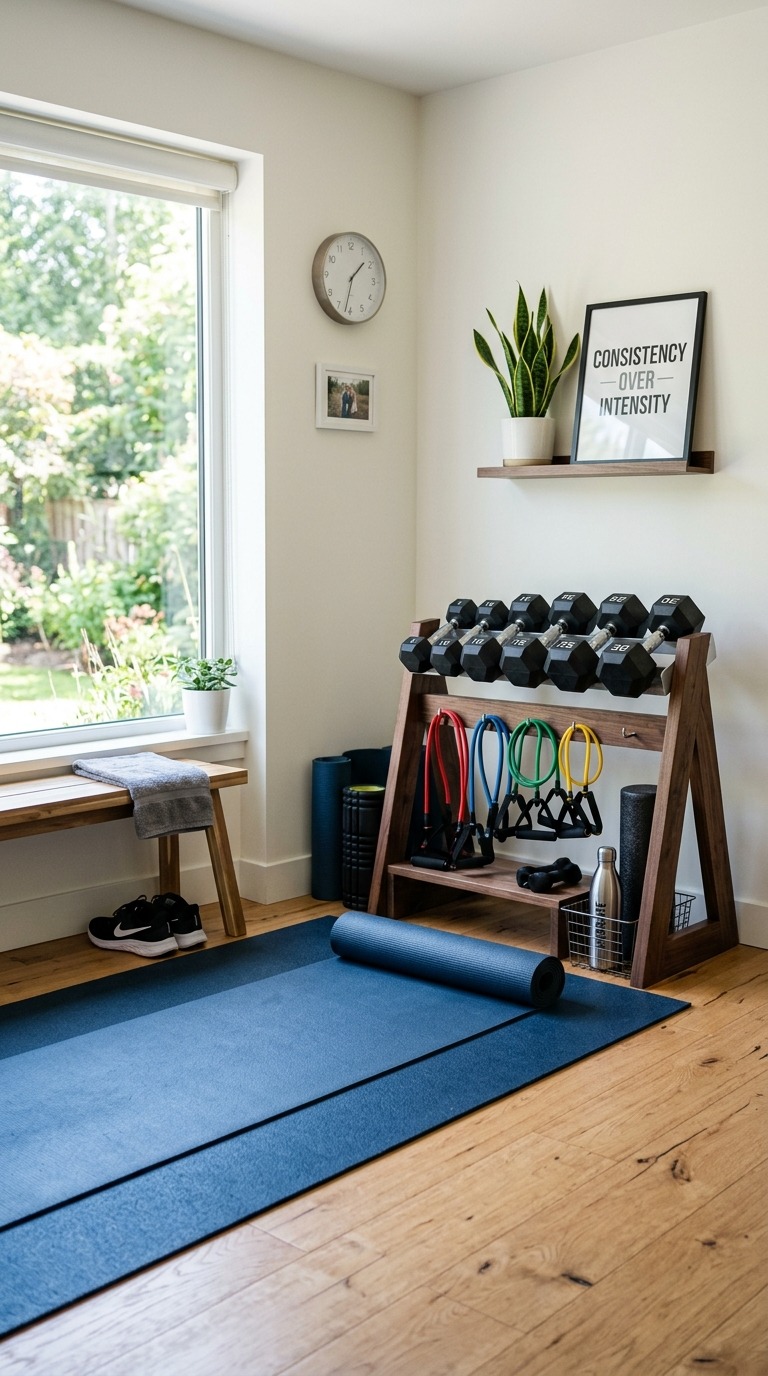
- Pick a simple two- or three-color palette for your mats, bands, and storage bins. choosing the right color palette
- Swap a floor bin for a wall-mounted rack. Looks more intentional, takes up zero floor space.
- Throw up a small mirror. It’s useful for checking form and it makes the whole space feel bigger and brighter.
- A cheap corner shelf or cart keeps gear visible instead of buried in a closet — and visible gear gets used more.
- String lights or one decent lamp can transform a garage or basement corner that otherwise feels like an afterthought.
You don’t need a $3,000 makeover here. A tidy, well-lit corner with matching bins will always beat a pile of expensive gear thrown in a heap.
Mistakes Women Make When Setting Up a Home Gym
A handful of patterns show up again and again. Worth naming so you can dodge them entirely.
Buying too heavy, too fast. Grabbing dumbbells that are more ambitious than your current strength leads to sloppy form and, eventually, just not using them. Start lighter than your ego wants.
Ignoring storage. Gear that’s out of sight gets used less — that’s just human nature. If your dumbbells are buried at the bottom of a closet behind winter coats, nobody’s grabbing them on a random Tuesday morning.
Overbuying before the habit sticks. It’s tempting to go all-in on day one. A smarter move: grab the essentials, use them consistently for a month, then fill gaps based on what you’re actually reaching for.
Skipping a mat or real flooring. Hard floors beat up your joints and make enough noise to annoy whoever’s downstairs. A mat or interlocking foam tiles solve both, cheaply.
No plan for progression. Equipment by itself doesn’t sculpt anything — a program that gradually increases resistance or reps does that. Buying gear with no plan to progressively challenge yourself is probably the number one reason home gyms fizzle out after a few weeks.
Small Space? Here’s How to Set Up Anyway
Forget the idea that you need a spare room. A corner, a closet, even a rolling cart can house a fully functional setup.
- Vertical storage — wall hooks or a slim rack keep bands and mats off the floor entirely.
- Foldable or collapsible equipment — foldable benches and collapsible steppers exist specifically for apartments like yours.
- Multi-use pieces — a stability ball that doubles as a bench, adjustable dumbbells instead of ten separate pairs.
- Rolling storage — a cart you can tuck away in a closet, pull out for a workout, then wheel right back.
Small home gym setups actually push you toward better decisions, since you can’t afford to buy things you’ll never touch. Think of that constraint as a feature, not a limitation.
Sample Weekly Routine Using Basic Equipment
Here’s a simple structure built around dumbbells, bands, and a mat. Three or four days a week is genuinely plenty to start seeing change.
Day 1 — Lower Body
- Goblet squats
- Romanian deadlifts (dumbbells)
- Band lateral walks
- Glute bridges
Day 2 — Upper Body
- Dumbbell shoulder press
- Bent-over rows
- Band pull-aparts
- Tricep dips (using a chair)
Day 3 — Rest or Active Recovery
- Walk, stretch, or light yoga on the mat
Day 4 — Full Body / Core
- Kettlebell or dumbbell swings
- Plank variations
- Jump rope intervals
- Band woodchoppers
Adjust the sets, reps, and rest to match where you’re at right now. The equipment matters way less than actually showing up week after week and gradually pushing yourself a little harder.
One Product Worth Buying
Product Name: Bowflex SelectTech Adjustable Dumbbells
Why it helps: This one piece of equipment solves two problems at once — running out of weight and running out of room to store more. Instead of buying five or six pairs of fixed dumbbells over the years, you get one adjustable pair that dials up or down depending on what you’re doing.
Key features:
- Dial-based weight adjustment system
- Replaces multiple sets of traditional dumbbells
- Compact storage footprint compared to a full dumbbell rack
- Durable design built for regular home use
Who should buy it: Anyone building a home gym who wants equipment that’s still useful a year from now, not just at their current strength level. Especially great if space is tight, since it replaces an entire rack of dumbbells with one pair.
Pros:
- Saves real space compared to owning multiple dumbbell pairs
- Grows with you as you get stronger
- One-time buy instead of repeated purchases down the line
Cons:
- Costs more upfront than a basic fixed-weight pair
- Takes a bit to get used to the dial mechanism
- Not the fastest option if you need to swap weights quickly mid-set
Final Thoughts
A home gym doesn’t need to look Pinterest-perfect or come stacked with every gadget on the market. What it actually needs is a handful of essentials, a bit of planning, and enough consistency to make the habit stick. Grab the basics — bands, adjustable dumbbells, a mat — get comfortable using them, and let the rest of your setup grow from there based on what you keep reaching for.
The best home gym setup was never the most expensive one anyway. It’s the one you’ll actually use on a random Tuesday when you really, really don’t feel like it.
FAQ
Do I really need a full home gym to see results? Not even close. Most visible changes in strength and body composition come from showing up consistently and gradually adding resistance, not from owning a huge equipment collection. A few well-chosen pieces will carry you far.
What’s the best starter equipment for a woman new to strength training? Resistance bands and a set of adjustable dumbbells cover almost everything a beginner needs. Toss in a mat for floor work and you’ve got a complete starting setup.
How much should I budget for a simple home gym? A functional setup can be built for under $150. More advanced setups with a bench, kettlebells, and a pull-up bar usually land somewhere between $300 and $600, though that varies a lot depending on brand and quality.
Can DIY workout equipment really replace store-bought gear? For beginners and lighter resistance work, yes, absolutely. Water jugs, towels, and backpacks work great as stand-ins while you figure out what you’ll actually stick with long-term.
How do I keep my home gym from turning back into a storage room? Keep everything visible and easy to grab. A wall rack or open shelf beats a closet every time. Out of sight really does mean out of routine here.
Is it better to buy a treadmill or focus on strength equipment first? For most goals, strength equipment gives you more bang for your buck in a small space. Cardio can be handled with a jump rope, bodyweight intervals, or just walking outside — saves both money and square footage.