
19 Jul Cardio Machines in Gym Layout: The Complete Guide to Workout Efficiency
Cardio Machines in Gym Layout: How to Set Up Your Space for Maximum Workout Efficiency
Walk into almost any gym and you’ll see it: treadmills shoved into a corner like nobody planned for them, a rowing machine wedged behind a pillar, bikes facing a blank wall for no reason anyone can explain. I used to think this stuff didn’t matter much. Then I built out a home gym in my garage, made every layout mistake in the book, and realized placement isn’t a cosmetic detail — it’s the difference between equipment you actually use and equipment that becomes a very expensive coat rack.
I’ve spent enough time on commercial gym floors and in my own garage to know the patterns that work and the ones that don’t. This guide covers all of it: the machines worth knowing by name, how real gyms plan their cardio floor, how to pull off the same thing at home even with limited square footage, how cardio fits alongside strength training in a smart floor plan, and the mistakes that trip up nearly everyone the first time around (myself included).
Why Cardio Machine Placement Actually Matters
Here’s the thing nobody tells you when you’re buying a treadmill: where you put it matters almost as much as what it is. Layout is a behavior problem dressed up as a design problem. A machine tucked into a dark, cramped corner gets ignored. The same machine facing a window gets used.
Commercial gyms figured this out a long time ago. That’s why cardio machines at the gym almost always sit near windows, mirrors, or the front entrance. It’s not an accident, and it’s not just about looking nice for new members walking in. Natural light and an open sightline make thirty minutes on an elliptical feel like fifteen. Stick that same elliptical against a bare wall and watch how much slower the clock moves.
There’s a safety angle too, and it’s not optional. Treadmills need clearance behind them in case someone stumbles off the back — which happens more than you’d think. Rowers and bikes need enough breathing room that you’re not clipping your neighbor mid-stroke. I learned this one the hard way at a crowded 24-hour gym where two rowing machines sat so close together that full extension meant elbowing the guy next to me. Not a great system.
Foot Traffic, Flow, and Why It Affects Your Motivation
There’s also a flow-of-traffic piece that most people never think about. Gyms design cardio zones so members can walk from the entrance to a locker room or water fountain without cutting through someone’s workout. Apply that same logic at home: if your treadmill sits directly in the path between the door and the rest of your equipment, you’ll subconsciously avoid using it because it feels like an obstacle course. Give your cardio equipment its own lane, even in a small room, and you’ll notice you use it more consistently.
Cardio Machines Names You Should Know (With Images)
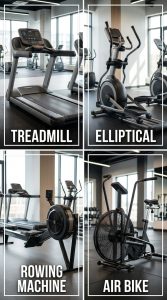
Before you plan any kind of layout, you need to actually know what you’re arranging. So here’s a quick rundown of cardio machines names you’ll run into, whether you’re at a commercial gym or shopping for your own setup:
- Treadmill – the classic. Walking, jogging, running, incline work, all in one machine.
- Elliptical trainer – low-impact, works your arms and legs together without pounding your joints.
- Stationary bike (upright) – the standard gym bike, more quad and core focused than you’d guess.
- Recumbent bike – reclined seat with back support. Easier on your joints and lower back.
- Rowing machine (erg) – full-body, brutal in the best way, great if you get bored on other cardio equipment.
- Stair climber / StepMill – an escalator you have to outrun. Absolutely torches your glutes.
- Air bike (assault bike / fan bike) – no resistance dial. The harder you push, the harder it pushes back.
- Ski erg – vertical pulling motion, common in CrossFit-style gyms.
- Vertical climber – a compact, standing machine that mimics climbing a ladder; low-impact but deceptively tough on the cardiovascular system.
- Jump rope – old-school, cheap, and still one of the most efficient cardio tools ever made if you’re honest about it.
If you’re trying to find cardio machines names with images so you can actually match a name to the piece of equipment in front of you, manufacturer sites like NordicTrack, Peloton, Concept2, and Life Fitness all have clean product photos. Worth a quick browse before you buy anything or wander a gym floor looking lost.
Impact Level Matters As Much As the Name
Not all cardio equipment loads your joints the same way, and this matters more than most buying guides admit. Treadmills and stair climbers are considered higher-impact because your feet strike a surface repeatedly. Ellipticals, recumbent bikes, rowing machines, and ski ergs fall into the low-impact category since your joints stay supported throughout the movement. If you’re managing knee pain, recovering from an injury, or just prefer to protect your joints long-term, leaning toward low-impact cardio equipment is generally the smarter call — and it’s a detail worth factoring into layout too, since low-impact machines are often quieter and gentler on flooring.
cardio machines collage images
How Commercial Gyms Layout Their Cardio Floor
Spend five minutes in a well-run commercial gym — a Snap Fitness, an LA Fitness, a boutique studio, whatever’s near you — and a pattern shows up fast, even if you’ve never consciously noticed it before.
Perimeter placement. Cardio machines in a gym floor plan almost always hug the outer walls, facing windows or a bank of TVs. That frees up the center of the floor for free weights, functional training, and turf work.
Rows facing the same direction. Treadmills and ellipticals line up in rows, typically all pointed toward the same wall. It’s not just neat — it means everyone’s looking at something worth looking at instead of staring at the person next to them.
Zoning by intensity. Stair climbers and assault bikes usually get grouped separately from recumbent bikes and easy-pace treadmills. Keeps newer gym-goers from feeling intimidated, and keeps the go-hard crowd from crashing into someone’s slow recovery session.
Clear walking lanes. Good gyms leave at least three feet behind every treadmill and enough clearance around every machine that nobody feels boxed in. It’s partly a liability thing, partly psychology — cramped gyms feel stressful whether members can articulate why or not.
Sound and airflow planning. Larger gyms also think about acoustics. Rows of treadmills generate a surprising amount of ambient noise and vibration, so commercial layouts often place HVAC vents and ceiling fans directly above cardio rows to keep the area from turning stale and loud at the same time.
Scale any of that down and it still works in a spare bedroom or a corner of a basement. The principles don’t change, just the square footage.
Best Layout Practices for a Home Gym
This is where it gets personal, because your space isn’t a 20,000-square-foot facility with a design team. It’s a garage, a basement, maybe a spare room if you got lucky on square footage.
A few lessons I picked up the hard way:
- Measure before you buy anything. A treadmill needs roughly 3 feet wide by 7 feet long including clearance — and that clearance isn’t a nice-to-have, it’s a real safety margin.
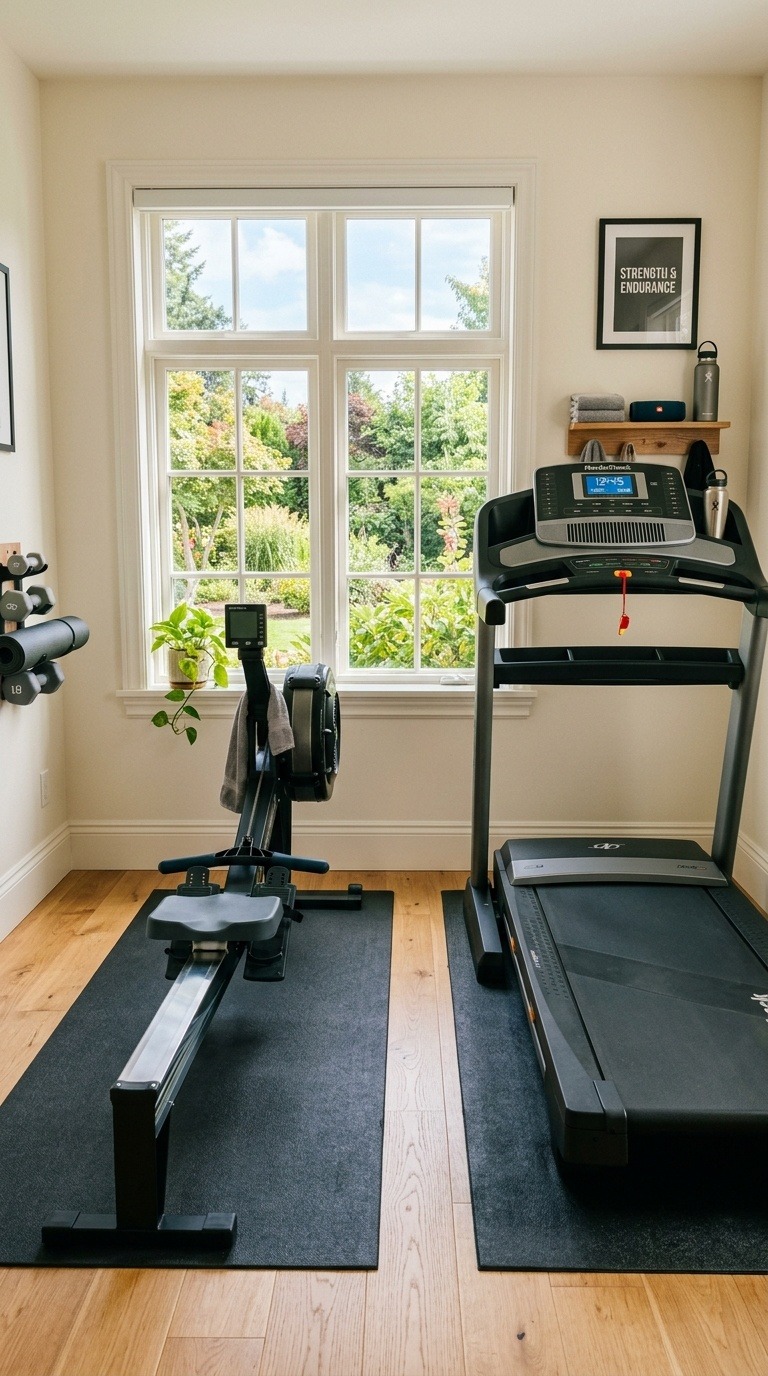
- Point your equipment at a window, TV, or mirror. Stare at a blank wall for twenty minutes and you’ll swear the clock is broken.
- Think about floor coverage while it’s in use, not just when it’s folded up. A foldable treadmill still eats floor space mid-workout, so plan around that footprint, not the storage one.
- Leave room to stretch. People forget mobility work needs its own patch of floor, and cramming it in as an afterthought never works.
- Group equipment by intensity if you’ve got more than one machine — same logic commercial gyms use, just on a smaller scale.
- Account for ceiling height, especially with a stair climber or vertical climber. Basements with low ceilings can make taller users feel cramped in a way that’s easy to miss until the equipment is already assembled.
One thing that caught me off guard: airflow matters more than I expected. A rowing session in a stuffy, unventilated room is miserable in a way that good lighting can’t fix. No window in your space? A decent fan pointed at your cardio zone isn’t optional — it’s the difference between finishing your workout and bailing halfway through.
Cardio Machine Dimensions Cheat Sheet
A quick reference for planning floor space before you buy anything:
| Machine | Approx. Footprint (In Use) | Ceiling Height Needed |
|---|---|---|
| Treadmill | 3 ft x 7 ft | Standard (8 ft+) |
| Elliptical | 2.5 ft x 6 ft | Standard (8 ft+) |
| Recumbent Bike | 2 ft x 5 ft | Standard |
| Upright Bike | 2 ft x 3.5 ft | Standard |
| Rowing Machine | 2 ft x 8-9 ft | Standard |
| Air Bike | 2.5 ft x 4 ft | Standard |
| Stair Climber | 3 ft x 4 ft | 8.5 ft+ recommended |
| Vertical Climber | 2.5 ft x 3 ft | 8 ft+ recommended |
These numbers vary a bit by brand and model, so treat this as a planning starting point rather than gospel — always check the manufacturer’s spec sheet for the exact machine you’re eyeing.
How Many Cardio Machines Does Your Space Actually Need?
This trips up more people than you’d expect. The instinct is to buy as much equipment as the budget allows, but a cluttered room with five machines you rotate through poorly usually gets used less than a tidy room with two you actually love.
A reasonable rule of thumb: for a single-person home gym, one primary cardio machine and one secondary option covers almost every training goal. Something like a treadmill for steady-state work paired with a rowing machine or air bike for intervals gives you enough variety without overcrowding the room. If more than one person in the household trains at the same time, you’re better off prioritizing two machines with a small footprint (say, a rowing machine and an air bike) over one large one, since it lets both people train simultaneously without cramping each other’s space.
Commercial gyms typically follow a ratio of roughly one cardio machine per 15-20 active members based on peak-hour usage, but that math obviously doesn’t translate directly to a home setup — it’s more useful as a reminder that even big facilities are deliberate about not overbuying equipment nobody has room to use properly.
Cardio Machines for Home: Space-Saving Picks
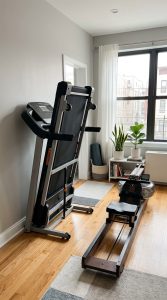
Not everyone has a spare room to hand over to cardio equipment, and that’s fine. The good news is compact options have gotten a lot better in the last decade — this isn’t the era of one clunky folding treadmill being your only choice.
- Foldable treadmills – slide under a bed or against a wall between sessions. Solid pick for apartments.
- Compact rowing machines – plenty now break into two pieces or store vertically in a closet.
- Under-desk or mini steppers – not a full workout by themselves, but useful when you’re short on both space and time.
- Air bikes – no folding mechanism, but a smaller footprint than a treadmill and no motor to maintain.
- Vertical climbers – some of the smallest standing cardio machines on the market, often foldable flat against a wall.
- Jump rope plus resistance bands – costs next to nothing, takes zero permanent floor space, and is still legitimately effective.
If I were setting up a small apartment, I’d skip the treadmill entirely and go with a rowing machine or air bike instead. Quieter for downstairs neighbors, no long runway needed, and honestly a better full-body burn per minute than most treadmill sessions anyway.
Apartment-Friendly Noise Considerations
Noise complaints are the number one reason apartment dwellers end up ditching a cardio machine. Motorized treadmills tend to be the loudest option, both from the motor itself and the repetitive footfall vibration that travels through floors. Magnetic resistance bikes and rowing machines are considerably quieter since there’s no motor involved at all. If noise is a real concern, look specifically for “magnetic resistance” in the product description and budget for an interlocking foam mat — it absorbs a surprising amount of impact noise for not much money.
foldable treadmill compact rower
Cardio vs. Strength Training: Where Cardio Should Sit in Your Layout
If your gym or home setup includes both cardio equipment and strength training gear, the layout question gets a little more interesting. Most well-designed spaces separate the two zones clearly rather than mixing them, and there’s a practical reason for it.
Cardio machines are stationary and repetitive — you’re in one spot for the duration of the session. Strength training, on the other hand, often involves moving between a rack, a bench, and open floor space for things like lunges or carries. Mixing the two zones creates a lot of unnecessary foot traffic crossing through someone’s cardio session, which is both distracting and a little unsafe if someone’s carrying a loaded barbell near a moving treadmill belt.
In a home gym, even a visual divider — a shelving unit, a floor mat color change, or just a few feet of open space — helps signal where one zone ends and the other begins. It also makes warm-up and cool-down routines feel more natural, since most people do a short cardio warm-up before lifting and want that machine within easy reach of the weight area without it being directly in the middle of it.
Beginner Gym Workout for Women: Where to Start on Cardio Machines
The cardio section can feel like the most intimidating corner of any gym when you’re new to it — machines everywhere, no obvious entry point, and a bunch of unwritten etiquette nobody bothers to explain.
So here’s a simple beginner gym workout for women (or genuinely anyone new to cardio machines) that eases you in without wrecking your joints or your confidence on day one.
Week 1–2:
- 10 minutes on a recumbent bike, easy pace
- 10 minutes walking on a treadmill, flat or slight incline
- 5 minutes stretching
Week 3–4:
- 15 minutes on an elliptical, moderate pace
- 10 minutes treadmill with incline intervals (2 minutes flat, 1 minute incline, repeat)
- 5 minutes stretching
Week 5+:
- Add a rowing machine for 10 minutes
- Short bursts on an air bike (30 seconds hard, 90 seconds easy, repeat 5-6 times)
The recumbent bike is honestly one of the best starting points out there. The seated position takes pressure off your lower back and knees, so you can build real cardiovascular endurance without the joint stress running throws at you right out of the gate. And don’t feel pressured to “graduate” to a treadmill eventually, either — plenty of experienced gym-goers stick with low-impact machines by choice, not because they have to.
A Note on Gym Etiquette Around Cardio Equipment
A few unwritten rules that make the cardio section less stressful for everyone: wipe down machines after use, keep sessions under 30 minutes during peak hours if people are waiting, and avoid resting on a machine between sets if someone else needs it. None of this is complicated, but it’s the kind of thing nobody tells beginners, and it makes a noticeable difference in how comfortable the space feels.
Cardio Machines Workout: Sample Routines by Machine
Different machines reward different strategies. Here’s how I’d actually structure a cardio machines workout depending on what you’re standing in front of.
Treadmill
- Steady state: 30 minutes at a conversational pace
- Intervals: 1 minute fast, 2 minutes recovery, repeat 8 times
- Incline walk: 20 minutes at 8-12% incline, moderate speed
Rowing Machine
- 500m sprints with 90 seconds rest, repeat 6-8 times
- 20-minute steady row at a sustainable stroke rate
Air Bike
- 20 seconds all-out, 40 seconds easy, repeat 10 times — short, but genuinely brutal
- 15-minute steady pace for a lower-intensity day
Elliptical
- 30-45 minutes steady, alternating forward and reverse motion to hit different muscles
- Bump up resistance every 5 minutes for a progressive burn
Stair Climber
- 15-20 minutes steady climb
- Don’t rush intervals here — the joint stress adds up fast if you’re not already conditioned for it
Choosing Between Steady-State and Interval Training
Steady-state cardio, sometimes called LISS (low-intensity steady state), keeps your heart rate in a moderate, sustainable range for a longer stretch of time. It’s easier to recover from and a good fit for beginners or anyone stacking cardio on top of a strength program. Interval training, often shortened to HIIT, alternates short bursts of near-maximal effort with recovery periods, and it tends to build cardiovascular capacity faster in less total time — but it’s also more taxing on your nervous system and joints, so it’s not something to do every single day. Most well-rounded routines use a mix of both rather than picking one exclusively.
The honest truth is variety matters more than any single “perfect” routine. Rotate between two or three machines a week and your body won’t plateau nearly as fast — and you won’t get bored, which is the real reason most people quit cardio in the first place.
Understanding Heart Rate Zones on Cardio Machines
Most modern cardio machines display heart rate data if you’re wearing a chest strap or gripping the sensor handles, and knowing how to read those numbers changes how useful your workout actually is.
- Zone 1 (50-60% of max heart rate): Very light effort, mostly used for warm-ups and active recovery.
- Zone 2 (60-70%): Comfortable, conversational pace. This is where most steady-state cardio should live, and it’s the zone associated with building aerobic base and long-term endurance.
- Zone 3 (70-80%): Moderate to hard. You can still talk, but not comfortably.
- Zone 4 (80-90%): Hard effort, typically used for structured intervals.
- Zone 5 (90-100%): Maximal effort, sustainable only for short bursts.
A rough (not perfectly precise) way to estimate your max heart rate is 220 minus your age. From there, the zones above are just percentages of that number. Machines with built-in heart rate monitors will often flash a zone indicator automatically, which takes the guesswork out of whether you’re actually training at the intensity you think you are.
Cardio Machines Timer: Getting Interval Training Right
Nearly every modern cardio machine has a built-in timer, and if you’re ignoring it, you’re leaving results on the table. A cardio machines timer isn’t just a clock ticking down your workout — it’s the backbone of interval training.
The basic logic behind interval timing:
- Work-to-rest ratio matters more than total time. Twenty well-structured minutes can beat forty-five unstructured ones.
- Beginners should start with longer rest periods — something like 30 seconds hard, 90 seconds easy — before pushing into more aggressive ratios.
- Advanced users can flip that ratio entirely, pushing 40 seconds hard against just 20 seconds of rest for a genuinely punishing session.
If your machine’s timer isn’t cutting it, a phone app or a cheap $15 interval timer clipped to the console works just fine. I use my phone on a magnetic mount on the treadmill — nothing fancy, works every time.
Cardio Machines Aesthetic: Building a Space You Want to Walk Into
This part gets skipped constantly, but the cardio machines aesthetic of your space genuinely changes how often you use it. Nobody’s excited to work out in a gray, cluttered corner that feels like storage overflow.
A few cheap ways to upgrade the vibe:
- Rubber flooring tiles – instantly makes a space read as “gym” instead of “garage.”
- A single accent wall – dark green, navy, or matte black behind your equipment photographs surprisingly well and just feels more intentional.
- String lights or a floor lamp – overhead fluorescents are functional but joyless. Warmer light changes the whole mood of a workout.
- A wall-mounted TV or tablet holder – lets you enjoy the twenty or thirty minutes instead of white-knuckling through it.
- A couple of plants – softens a room full of metal and rubber. A snake plant survives low light just fine, so no green thumb required.
- Mirrors along one wall – beyond checking form, mirrors make small rooms feel noticeably larger and brighter, which matters a lot in a converted closet or basement corner.
None of this is required to get a good workout, obviously. But there’s real psychology at play — spaces that feel good to be in get used more, and consistency is basically the whole game with cardio.
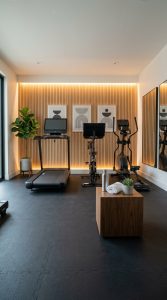
home gym cardio machine setup
Common Layout Mistakes People Make
I’ve made most of these myself, so think of this as your shortcut past the trial and error.
- Facing equipment toward a blank wall instead of a window or screen. Boring view, shorter attention span, workouts that feel like a chore.
- Skipping clearance behind treadmills. This isn’t a spacing preference — it’s a real safety issue.
- Cramming too many machines into too little space. One machine you’ll actually use beats three you’re tripping over.
- Ignoring noise and vibration. Treadmills on upper floors or over bedrooms can genuinely disrupt a household without a mat underneath to absorb impact.
- Buying a machine before measuring the room. Sounds obvious. It’s still the single most common regret I hear about from people building home gyms.
- Skipping ventilation entirely. A stuffy room turns even a great machine into one you’ll start avoiding.
- Placing cardio equipment too close to a power outlet without a surge protector. Treadmill motors especially draw a lot of current, and daisy-chaining them off an overloaded extension cord is a genuine fire risk.
- Forgetting about flooring compatibility. Heavy machines on carpet can sink unevenly over time, while hardwood floors can get scuffed or dented without a protective mat underneath.
Which Cardio Machine Is Right for You? A Real Comparison
| Machine | Best For | Impact Level | Space Needed | Price Range |
|---|---|---|---|---|
| Treadmill | Runners, walkers, incline training | Moderate-High | Large | $$-$$$$ |
| Elliptical | Low-impact full body cardio | Low | Large | $$-$$$$ |
| Recumbent Bike | Beginners, back/joint issues | Very Low | Medium | $-$$$ |
| Upright Bike | Compact spaces, quad focus | Low | Small | $-$$ |
| Rowing Machine | Full-body strength + cardio | Low-Moderate | Medium | $-$$$ |
| Air Bike | High-intensity intervals | Moderate | Small-Medium | $$-$$$ |
| Stair Climber | Glute/leg focus, advanced users | High | Medium | $$$-$$$$ |
| Vertical Climber | Compact spaces, full-body low-impact | Low-Moderate | Small | $-$$ |
| Jump Rope | Budget, small spaces, portability | High | Minimal | $ |
If I had to pick just one machine to start a home gym with, it’d be a rowing machine, no contest. It’s genuinely full-body, easier on the joints than running, doesn’t need a massive footprint, and scales from a gentle beginner pace all the way to brutal sprint intervals without ever needing an upgrade.
Maintenance and Safety Basics Nobody Talks About
Buying the machine and finding it a good home is only half the job. A few things people skip way too often:
- Wipe down and lubricate treadmill belts every few months depending on use. Dry belts wear faster and can slip when you least expect it.
- Check bolts and stability on bikes and ellipticals every couple of months. Regular vibration loosens things over time, quietly.
- Keep a mat under any motorized machine, both for noise and to catch the dust and debris that clogs moving parts.
- Unplug electronic machines during storms if you’re anywhere prone to power surges. Consoles are not cheap to replace.
- Leave yourself an exit path. In an emergency, the last thing you want is your only way out blocked by a treadmill.
- Inspect rowing machine chains and cables for fraying every few months, especially if the machine sees heavy daily use.
- Recalibrate resistance settings on air bikes and ellipticals periodically, since fan-based resistance mechanisms can drift slightly out of sync over time.
When to Call It Quits on an Old Machine
Most home cardio equipment has a realistic lifespan of somewhere between 7 and 12 years with regular maintenance, though motorized treadmills on the lower end of that range if they’re used daily. Warning signs it’s time to replace rather than repair include a motor that overheats during normal use, a belt that won’t stay aligned no matter how many times you adjust it, or a console that’s lost the ability to accurately track resistance and speed. At that point, repair costs often approach the price of just replacing the unit.
Wrapping Up
Getting your cardio machines in gym layout right, whether that’s a full commercial floor or a corner of your garage, comes down to a handful of repeatable ideas: give equipment room to breathe, point it toward something worth looking at, group machines by intensity, and don’t skip the boring stuff like ventilation and clearance. None of it is complicated. It’s just easy to overlook until you’re the one squeezed between two treadmills at 6 a.m., wondering why nobody planned this better.
Start with one or two machines that actually fit your space and your goals instead of trying to cram an entire commercial gym floor into your basement. A rowing machine and a jump rope in a well-lit, well-ventilated corner will take you further than a cluttered room full of equipment you dread walking into.
FAQ
What’s the best cardio machine layout for a small home gym? Prioritize one or two machines over cramming in more. A rowing machine or air bike works well in tight spaces since neither needs the long runway a treadmill requires.
How much space does a treadmill actually need? Plan for roughly 3 feet of width and 7 feet of length, including at least 2-3 feet of clearance behind it for safety.
Are recumbent bikes good for beginners? Yes. The seated, reclined position takes strain off your lower back and knees, making it one of the friendliest cardio machines out there for someone just starting.
How do commercial gyms decide where to place cardio machines? Most place cardio equipment along the perimeter, facing windows, TVs, or mirrors, with rows oriented the same direction and clear walking lanes maintained throughout.
What cardio machine burns the most calories? Depends heavily on intensity and individual effort, but rowing machines and air bikes tend to engage more total muscle mass per minute than something like a recumbent bike, which can translate to a higher calorie burn at a similar perceived effort.
Do I need a timer for interval cardio workouts? It helps a lot. A dedicated cardio machines timer, or even a basic phone app, keeps your work-to-rest ratios consistent, and that consistency matters more for results than total workout time.
Should cardio machines face a mirror or a window? Either works, but they serve different purposes. Mirrors help with form and posture, especially useful on machines like ellipticals or ski ergs where technique matters. Windows tend to make longer steady-state sessions feel less monotonous. If your space allows for both, positioning primary equipment near a window and using a side wall mirror for form checks covers both bases.
Is it better to do cardio before or after weight training? For most people, doing a short cardio warm-up before lifting and saving longer cardio sessions for after (or a separate day) works best. Heavy steady-state cardio before a lifting session can pre-fatigue muscles and slightly reduce strength output, though light cardio as a warm-up is generally fine and even beneficial.
How far apart should cardio machines be spaced from each other? A minimum of 2 feet of side clearance between machines is a reasonable baseline for home gyms, though commercial facilities often aim for closer to 3 feet to account for arm swing on ellipticals and rowing machine slide length.
What’s the quietest cardio machine for an apartment? Magnetic resistance bikes and rowing machines are generally the quietest options since they don’t rely on a motor. Treadmills tend to be the loudest due to both motor noise and footfall impact, even with a mat underneath.
How many calories does 30 minutes on a cardio machine actually burn? It varies a lot by machine, intensity, and body weight, but rowing machines and air bikes generally burn calories at a faster rate than recumbent bikes at a comparable perceived effort, simply because more muscle groups are engaged at once.
Can I put a treadmill on carpet? It’s possible, but not ideal without a hard, flat surface underneath, like a dedicated treadmill mat. Thick carpet can cause the machine to sit unevenly, which affects belt alignment and motor strain over time.
Product Recommendation
Product Name: Concept2 Model D Indoor Rowing Machine
Why It Helps: It’s one of the most respected rowing machines out there, used in commercial gyms and CrossFit boxes alike, which makes it a safe bet for anyone building a home cardio setup that needs to grow with them instead of getting outgrown in six months.
Key Features:
- Air resistance flywheel that adjusts naturally to your effort level
- PM5 performance monitor tracking pace, distance, calories, and stroke rate
- Breaks down into two pieces for storage
- Durable stainless steel rail
Who Should Buy It: Anyone setting up a home gym who wants a real full-body cardio option without needing to dedicate an entire room to it.
Pros:
- Low-impact on joints compared to running
- Compact storage when not in use
- Well-documented workout programs available online
- Long track record of reliability
Cons:
- Higher upfront cost than a basic exercise bike
- Still needs floor space when it’s in active use
- Can get noisy on hard flooring without a mat underneath