
20 Sep Why the GHD Machine Is Back in the Spotlight in 2026
Why the GHD Machine Is Back in the Spotlight in 2026
If you’ve ever walked into a serious gym and wondered what that strange padded machine was, you’re not alone. The GHD machine, or Glute-Ham Developer, isn’t exactly self-explanatory.
At first glance, it can look like a very specialized bench. But once you understand how it works, the purpose becomes much clearer. A GHD gives you a way to train your hamstrings, glutes, lower back, and trunk through movements that are difficult to replicate on a regular bench.
And lately, it’s getting more attention from home-gym owners.
Part of that interest comes from people looking for better ways to train the posterior chain. Reddit discussions also show something else: people are trying to figure out whether a full-size GHD deserves valuable floor space, or whether a smaller or DIY setup can do enough of the job. (reddit.com)
So, what does a GHD machine actually do, and why would someone want one?
Key Facts at a Glance
- GHD stands for Glute-Ham Developer.
- It is mainly used for posterior-chain training.
- The major muscles involved include the hamstrings, glutes, spinal erectors, and trunk muscles.
- Common exercises include glute-ham raises, hip extensions, back extensions, and GHD sit-ups.
- Unlike a basic leg-curl machine, a GHD can involve both hip extension and knee flexion.
- A GHD can take up a significant amount of floor space.
- Proper setup and controlled movement matter, especially for beginners.
- It is a specialized training tool, not a replacement for your entire lower-body program.
So, What Is a GHD Machine?
Let’s start with the name.
GHD means Glute-Ham Developer. The machine was designed around training the glutes and hamstrings, although those aren’t the only muscles involved.
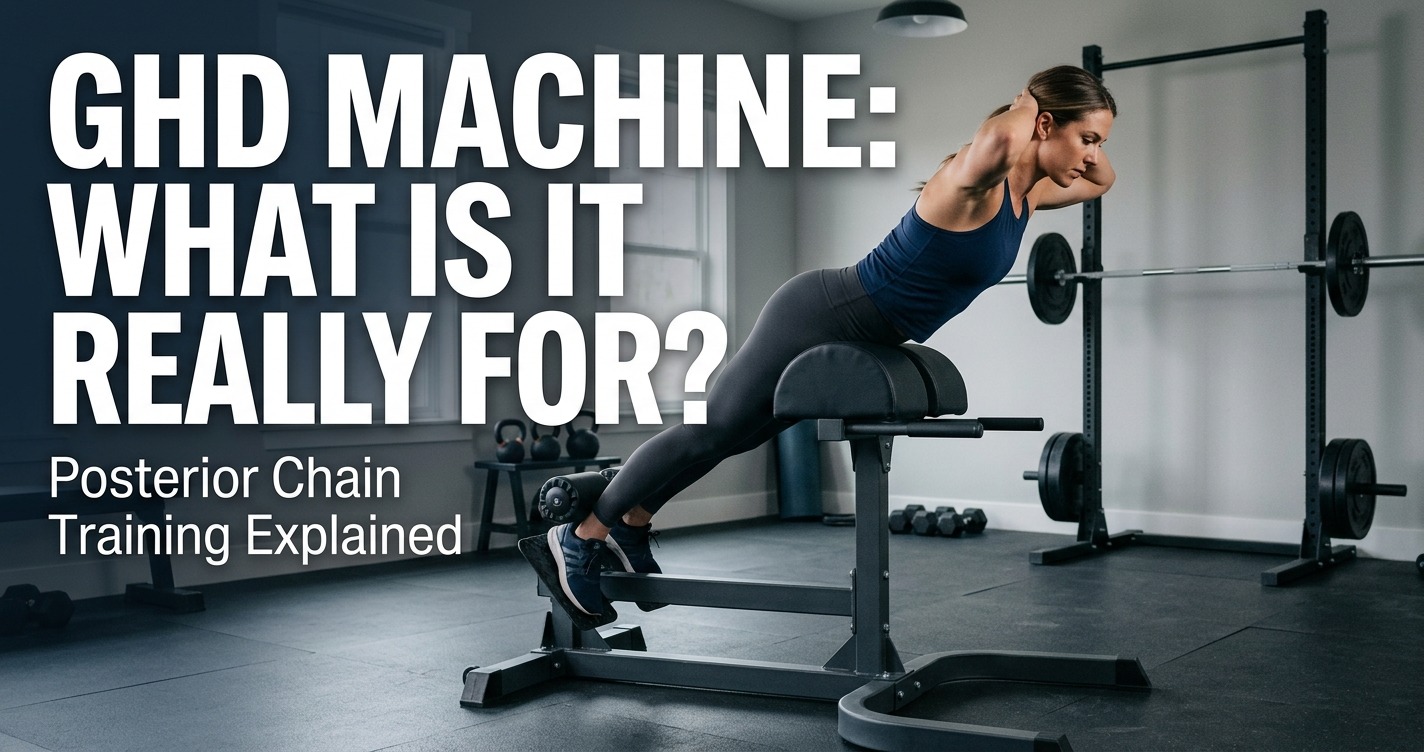
A typical GHD has a padded support for your hips or torso and adjustable foot and ankle supports. Your feet are secured while your body moves around the pad.
That setup lets you perform several different exercises.
The most recognizable is probably the glute-ham raise. You start with your body supported, lower yourself under control, and then use your hamstrings and glutes to bring yourself back up.
But that’s only one use.
Depending on the setup, a GHD can also be used for hip extensions, back extensions, and GHD sit-ups. Changing your position changes the movement and, consequently, which muscles are doing more of the work. (functionalathletes.com)
That’s what makes the machine more interesting than it first appears.
What Does a GHD Actually Train?
The simplest way to understand a GHD is to think about the posterior chain.
That’s basically the group of muscles running along the back side of your body.
Hamstrings
Your hamstrings aren’t just knee-bending muscles.
They cross both the knee and hip, which means they can help with knee flexion as well as hip extension.
That’s one reason GHD exercises feel so different from something like a seated or lying leg curl. Research into hamstring function supports the idea that changing the combination of hip and knee movement can change the demands placed on the hamstrings. (sciencedirect.com)
Glutes
The glutes are major hip extensors, so they’re naturally involved in several GHD movements.
How much they contribute depends on the exercise and body position. Research has found that changing hip and knee angles can affect the relative contribution of the glutes and hamstrings during hip-extension movements. (pubmed.ncbi.nlm.nih.gov)
Lower Back
Your spinal erectors also have a role.
During many GHD movements, your trunk has to stay controlled while your hips and legs move. That makes the machine relevant to more than just hamstring training.
Still, there’s an important distinction here.
The goal isn’t to throw your back around as quickly as possible. Controlled movement matters.
Core
A GHD can also become a trunk-training station.
The classic example is the GHD sit-up. Because your body can travel through a much larger range than during a typical floor sit-up, the exercise feels very different.
More range, however, doesn’t automatically mean better results.
It’s the quality of the movement that matters.
The Main GHD Exercises
If you’re new to the machine, these are the movements you’ll come across most often.
1. Glute-Ham Raise
This is probably the exercise most people associate with the GHD.
Your feet are locked into position while you lower and raise your body using your hamstrings and glutes.
The lowering portion can be particularly challenging.
If you’ve never tried one before, you may discover very quickly that a full repetition is harder than it looks.
That’s why beginners often need an easier variation or assistance before trying strict, full-range repetitions.
2. Hip Extension
Hip extensions focus more directly on movement around the hip.
The idea isn’t to see how quickly you can fling your upper body upward. A controlled repetition allows the hips and posterior chain to do the work without turning the exercise into a momentum contest.
3. Back Extension
A GHD can also be used for back-extension movements.
This makes it somewhat comparable to a 45-degree back-extension machine, although the body position and mechanics aren’t identical.
4. GHD Sit-Up
Turn around on the machine and you can use it for GHD sit-ups.
The movement allows the torso to travel through a large range of motion.
That can make the exercise challenging, but it also means beginners shouldn’t assume they need to copy high-repetition workouts they see online.
Start with what you can control.
Why Are People Talking About GHD Machines Again?
The GHD isn’t new.
That’s worth pointing out.
What seems to be changing is the way people are thinking about posterior-chain training in home gyms.
A 2023 Reddit discussion about posterior-chain equipment highlighted growing interest in machines and attachments designed specifically for the hamstrings, glutes, and related movements. (reddit.com)
More recently, home-gym users have been discussing compact and DIY GHD setups.
One 2025 Reddit project explored a more space-conscious GHD-style arrangement. A 2026 discussion also showed a DIY approach to glute-ham raises using adjustable gym components. (reddit.com)
That trend makes sense.
Home gyms don’t usually have unlimited space.
Most people are trying to fit a rack, weights, bench, storage, and cardio equipment into a garage, basement, spare bedroom, or other limited area.
So the question isn’t simply whether a machine works.
It’s whether the machine earns the space it takes up.
GHD Machine vs. Other Hamstring and Posterior-Chain Exercises
A GHD isn’t automatically better than every other option.
In fact, comparing it with alternatives is probably the easiest way to understand what makes it different.
Mobile tip: Hold and slide the horizontal bar underneath the table to see the complete comparison.
The important thing here is that these exercises aren’t doing exactly the same job.
A leg curl is mostly about knee flexion.
A Romanian deadlift is primarily a loaded hip hinge.
A Nordic hamstring exercise puts a lot of emphasis on eccentric hamstring strength.
The GHD sits somewhere in the middle of several of these categories, depending on how you’re using it.
What Does the Research Say?
There isn’t nearly as much GHD-specific research as there is on more common exercises such as squats, deadlifts, and leg curls.
That’s important context.
Still, available research gives us useful information about the movement.
One kinematic study of the GHD exercise found involvement from the iliopsoas, erector spinae, rectus femoris, hamstrings, and rectus abdominis. The researchers also described the exercise as complex and emphasized the importance of developing sufficient strength and learning the movement properly. (revista.cpaqv.org)
Other research looking at hip-extension mechanics has found that changing hip and knee positions can affect the contribution of the glutes and hamstrings. (pubmed.ncbi.nlm.nih.gov)
There’s also broader research on hamstring training.
Studies of Nordic hamstring exercises, for example, have looked at how hip position influences hamstring activity and force production. (pubmed.ncbi.nlm.nih.gov)
The bigger lesson is pretty simple:
Exercise selection changes the way your muscles are challenged.
That doesn’t mean the GHD wins some universal “best hamstring exercise” contest. It means it offers a particular combination of movement demands that some people may find useful.
What Home-Gym Owners Say About GHDs
This is where Reddit discussions become interesting.
People who own home gyms tend to talk about things that don’t always show up on a product specification sheet.
The biggest issue?
Space.
One home-gym discussion about a Titan GHD focused heavily on its footprint and how much room the machine actually occupies. (reddit.com)
That’s a very real issue when your gym is in a garage or spare room.
Another discussion from a GHD owner highlighted the machine’s versatility, while also mentioning that getting used to changing configurations can take some time. (reddit.com)
And then there are the DIY builders.
Some home-gym enthusiasts are creating their own GHD-style setups instead of dedicating a large amount of space to a traditional commercial machine. (reddit.com)
That tells us something about where home-gym equipment is heading.
People want more training options, but they don’t necessarily want more stuff.
A GHD Isn’t Just a Fancy Bench
It’s easy to look at a GHD and think, “Why can’t I just do this on a bench?”
Sometimes you can get a similar movement.
But the setup is different.
A standard bench mainly supports your body. A GHD positions and anchors your body for specific movements.
Your feet are secured, your hips or torso rest against a pad, and your body can move around that fixed point.
That’s what gives the GHD its particular training possibilities.
It’s also why setup matters.
If the machine is positioned poorly for your body, an exercise can feel completely different from what you expected.
Is a GHD Useful in a Home Gym?
That depends on what you’re actually trying to train.
If your gym already has a rack, barbell, dumbbells, bench, and a good way to train your hamstrings, a GHD is probably a specialized addition, not a foundation piece.
If you regularly train glute-ham raises, hip extensions, or other posterior-chain movements, the situation is different.
Then the machine may fill a genuine gap.
Space should also be part of the conversation.
Our budget-friendly home gym setup guide looks at the broader idea of building a useful gym without filling every available square foot. (gymequipage.com)
That’s particularly relevant to GHDs because their footprint can be substantial.
For smaller spaces, our coverage of hybrid training stations also looks at why multifunctional equipment can make sense when floor space is limited. (gymequipage.com)
What About GHD Sit-Ups?
GHD sit-ups deserve a little extra attention.
They’re often the first movement people notice because they look simple.
They’re not necessarily simple.
The machine allows your torso to travel through a much larger range of motion than a typical floor sit-up. That changes the exercise considerably.
If you’re new to GHD training, there’s little reason to jump straight into high-volume repetitions.
Learn the movement first.
Get comfortable with the setup.
Then gradually increase the workload.
The goal isn’t to make the exercise look dramatic. The goal is to make the movement controlled and repeatable.
The Biggest Issue for Home Gyms: Floor Space
Let’s be honest.
For many people, space is the real deciding factor.
A commercial gym can dedicate an entire area to a GHD.
A home gym often can’t.
Your garage may still need to fit a car. Your basement might also be storage. Your spare room might need to remain usable for something besides working out.
That changes how you evaluate equipment.
A machine that gets used several times a week can justify its footprint.
A machine that sits untouched for months becomes a very expensive piece of furniture.
That’s one reason compact and DIY GHD ideas keep appearing in home-gym communities. (reddit.com)
Where Does the GHD Fit in a Modern Home Gym?
Think of your gym equipment in two groups.
First, there are the general-purpose pieces: racks, barbells, dumbbells, benches, and cable systems.
Then there are the specialized pieces.
The GHD belongs in that second group.
That’s not a criticism.
Specialized equipment can be extremely useful when it matches the way you train.
But it shouldn’t automatically be treated as a requirement.
The same idea applies to other large machines. Our guide to home-gym Smith machines looks at another example of equipment that can offer several training options while taking up meaningful floor space. (gymequipage.com)
The common question is always the same:
Will you actually use it?
What This Means for You Going Forward
The GHD machine isn’t replacing squats.
It isn’t replacing deadlifts.
And it certainly isn’t the only way to train your hamstrings.
What it does is give you a dedicated setup for a particular group of movements, especially those involving the posterior chain, hip extension, knee flexion, and trunk control.
For a serious home-gym enthusiast, that can be valuable.
For someone with limited space who rarely performs GHD-specific movements, it may make much less sense.
That’s the part that often gets lost when gym equipment becomes trendy online.
The question isn’t whether a machine looks useful.
The question is whether it solves a problem in your training.
If you’re planning a compact gym, our at-home gym equipment guide provides another look at how versatile equipment can be balanced against available space. (gymequipage.com)
The Bottom Line
The GHD machine is a specialized piece of equipment with a very specific job.
Its real value comes from giving you a controlled platform for movements that challenge the hamstrings, glutes, trunk, and lower back in ways that aren’t identical to a leg curl or Romanian deadlift.
That’s why the machine continues to attract attention.
But the interesting story in 2026 isn’t that everyone suddenly needs a GHD.
It’s that home-gym lifters are looking for smarter ways to train the posterior chain while dealing with a very ordinary problem: limited space.
That is why full-size machines, compact designs, and DIY GHD setups are all part of the conversation.
In other words, don’t ask whether the GHD machine is “the best.”
Ask whether the training it provides is something your gym is currently missing.
That’s the question that actually matters.