
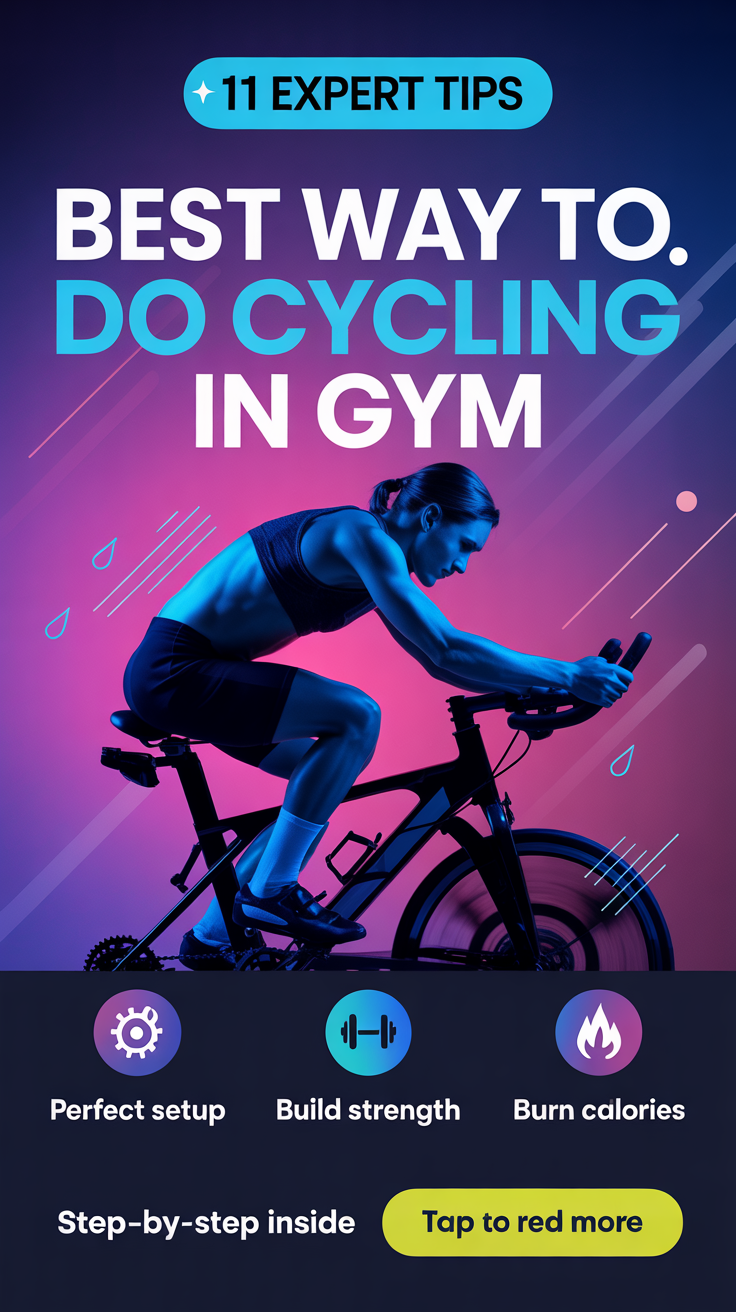
01 Jan How to do Cycling in Gym: 11 Expert Tips
Learning how to do cycling in gym areas will radically change a boring indoor experience into an extremely efficient one. It does not matter whether you are new to stationary bikes or you want to maximize your time in the gym riding a bicycle, it is all about proper techniques and strategies that will help you achieve your fitness target.
The indoor biking in the gym provides a controlled environment whereby you can concentrate fully on your shape, intensity and performance without having to think about traffic, weather and landscape. The point is that it is essential to know how to correctly assemble your bike, organize your exercises, and be motivated during your fitness process.
Before you start peddling the bike, master proper bike setup.
Proper positioning of the bike is paramount to comfort, injury avoidance as well as power generation. This is the step that most people do not take and they end up wondering why their knees are hurting or uncomfortable after only 10 minutes of riding.
Begin with the adjustment of the seat height. At the point of bottom of the pedal stroke, your knee is supposed to have slight bend of about 25-35 degrees. Get the bike and position the seat to a height of about hips.
Seat Position Guidelines:
– Forward/backward position: when cranks are horizontal knee has to be over the pedal spindle.
– Handlebar height: even with the seat or a bit higher in case of beginners.
– Distance to handlebars: can reach without overstretching.
Check out all the things prior to beginning your work out.
It is also important where you place your handlebar. When you are too forward-bent or are hunching over, you will become tired too soon, and may overwork your back, or your shoulders, needlessly.
Choose the Correct Resistance Levels to Your Objectives.
The problem of resistance is the key to understanding how to do cycling in the gym settings successfully. Lack of resistance will make you merely spinning without gaining any strength, whereas excessive resistance may destroy your shape and cause an injury.
When training endurance, maintain a moderate resistance at which you are comfortable with 80-100 RPM. You are supposed to feel that you are working yet you may be able to continue doing it 30-45 minutes and still not feel totally exhausted.
Resistance Level Framework:
– Light resistance (1 3): Warm-up and rest intervals.
– Moderate (4-6): steady state cardio and endurance training.
– High resistance (7-9): Strengths intervals and hill climbs.
– Peak resistance (10): Sprinting only.
The heavier resistance of 60-70 RPM is needed during strength-oriented intervals. Imagine that you are riding a steep hill and you have to put real effort into every stroke of the pedal and yet you are able to keep your ride under control.
Master Your Pedding Style and Shape.
Efficient pedaling is to push down and pull up all the way through the entire rotation instead of just mashing down on the pedals. This rotational movement involves additional muscles and eliminates the stress on the joints greatly.
Pay attention to maintaining your core and keeping your upper body quite stationary. Your legs must do all the work and your torso should be used as a stable base of force.
Form Checklist:
Shoulders not bent, but down.
– Forward-bent elbows, never bent.
– Deep muscles involved all round.
– Hips do not rock on their sides.
– Knees do not splay out, they go straight.
Your stance on your feet is also important. Your foot ball must be over the spindle of the pedal. Riding with your arches or toes results in poor power transfer and may lead to numbness in the feet when riding longer distances.
Plan Your Fitness with Intention and Diversity.
Ad hoc pedaling is not going to achieve the outcomes you are looking. Designing exercises is crucial towards advancing your fitness status and ensuring that you are not bored enough to give up completely.
The calorie burning and cardiovascular fitness of interval training is more efficient than steady-state riding. Switch high-intensity intervals and rest intervals to push your body differently.
Level 30 Minute Interval Workout:
1. 5 minutes: Warm-up at low resistance at ease.
2. 1 minute: Moderate heavy intensity at high resistance.
3. 2 minutes: Light resistance recovery.
4. Repeat the interval 6 times.
5. 5 minutes: Easy peddling with cooling down.
Long extended rides develop stamina and resilience of mind. Arrange at least one 45 60 minutes ride per week at a pace that is sustainable and you can have a conversation in case of necessity.
Measure Your Metrics to Track Your Improvement.
Monitoring key performance indicators will reveal to you what exactly is working and where you have to change your course of action. The majority of gym bikes have cadence, resistance level, time, distance, and estimated calories burned.
The amount of effort you are at is given to you instantly because of your cadence (pedal revolutions per minute). Endurance rides should be kept at 80100 RPM by professional cyclists, which is also a good goal of most gym-goers.
Important Metrics to Track:
– RPM/Cadence: 80-100 cardio, 60-70 strength.
– Heart rate: Work within your target ranges towards certain objectives.
– Power output: Measured actual work (where possible)
– Total distance: Measure weekly and monthly progress.
– Mean resistance: Linearly increase with time.
Heart rate zones assist in training at the right intensity levels. A moderate cardio is generally 60-75 percent of your top heart rate, whereas high-intensity intervals take you to 80-90.
Add Standing Climbs to Engage Wholesome Body.
Riding a bike and standing will work your glutes, core and upper body much more than riding a bike sitting up. This difference also disrupts the boredom of longer workouts besides providing functional strength training advantages.
Before getting up, increase your resistance to a greater extent. You should have sufficient resistance to sustain your weight without losing control and bouncing about.
Proper Standing Technique:
– Have hips in front of the pedals straight, not too far.
– Be in balance with handlebars only by making light contact.
– Core pulls in to stabilize your spine.
– Shoulders do not tense although they work harder.
– Breathe in and out at a slow pace.
Begin with short periods of standing of 3060 seconds until you gain strength and coordination. These periods should be extended to 2-3 minutes during climbing passages as you get better.
Couple Your Breathing to Your Pedal Cadence.
The breathing under control is an enormous boost to your stamina and strength in the biking sessions. The hard efforts cause many people to stop their breathing and this soon causes fatigue and poor performance.
Find a breathing pattern that is in sync with your pedaling. One of the widely used techniques is to inhale 3-4 pedal strokes and exhale 3-4 strokes and repeat the process during your workout.
Breathing Strategies:
– Natural, easy breathing: Easy breathing using your nose.
– Moderate intensity: Breathing is deep in the belly, breathing in through nose, breathing out through mouth.
– Hard breathing: Rapid and strong mouth breathing.
– Recovery: Deep, slow breathing to reduce the heart rate.
When the efforts are high, concentrate on hard breathing. This will automatically induce a deeper breathing and clearance of carbon dioxide in your body more effectively.
Use Music and Entertainment to Your Advantage.
The appropriate music turns your bike riding experience into a boring necessity rather than an exciting workout that you enjoy. Studies indicate that music with 120140 beats per minute automatically stimulates the best cycling cadence.
Prepare various playlists in respect to various types of workouts. Tunes with fast beats are ideal during interval sessions and slower tempo songs are more appropriate during endurance rides.
Entertainment Options:
– Fast playlists to keep up with your desired cadence.
– Bike-based exercise classes or videos.
– Longer easier rides on podcasts.
– Auditory books when exercising at a steady state.
– Netflix or watch programming on gym bikes.
Gyms have become equipped with bikes that have entertainment screens. Only use your favorite shows during cycling workouts to establish positive associations and motivation to ride the bike.
Time off Rides to avoid burnout.
Working hard at each session is in fact counterproductive as your body never has sufficient time to rest. Long-term improvement and injury prevention require easy recovery rides.
Recovery rides are supposed to be just too easy. You are riding on a low resistance (2 -4) and talking at a reasonable speed, and working on having a smooth peddling motion, not on power production.
Recovery Ride Guidelines:
– Duration: 20‑40 minutes maximum
– Intensity: 50-65% of the maximal heart rate.
– Cadence: 80-90 RPM and low resistance.
– Frequency: 1-2 times in a week between harder sessions.
– Intention: Not intensity training, active recovery.
These less rigorous sessions are more effective in supplying more blood to fatigued muscles without causing extra fatigue. Regular recovery rides will in fact make you perform better next time you engage in a strenuous workout.
Keep Hydrated During Your Workout.
Dehydration is performance killer in indoor cycling, almost nothing like dehydration. Gyms are known to be stuffy in comparison to outdoor riding and as a result, you will be dripping even when performing moderate-intensity exercises.
Begin to hydrate 2-3 hours prior to cycling. Consume 16-20 ounces of water in order to be in a perfect state of hydration when you start your workout.
Hydration Strategy:
– Pre workout: 16-20 oz water 2-3 hours before.
– Workout: 7-10 oz at 10-15 minute intervals.
– Post workout: 16-24oz per pound of sweat loss.
– Electrolytes: Add them when it is more than 60 minutes.
– Temperature: Cool water absorbs as compared to room temperature.
Keep the water bottle at hand with the bike. It is also better to take small, frequent sips than to gulp large portions once in a while.
Take a Break and Stretch Major Muscle Groups.
One of the most popular mistakes that people commit when they are learning how to do cycling in the gym setting the best way is to end your workout without cooling down. Proper cool-down also helps in recovery and lessening soreness on the next day by a significant margin.
Ride 5-10 minutes with the highest resistance to slow down your heart rate. This will avoid the blood remaining in your legs and will lessen the dizziness some people get when suddenly they stop.
Post‑Cycling Stretches:
– Quadriceps: Standing quad pull, 30 seconds each leg.
– Hamstrings: Seated forward bends, pose 30-45 seconds.
– Hip flexors: Low lunge, hold 30sec/side.
– Calves: Wall calf stretch, hold 30 seconds a leg.
– Back muscles: lower back: child pose or cat-cow position.
Particular attention should be paid to hip flexors and quadriceps as cycling will keep these muscles in shortened position during the exercise. By stretching them, tightness that may improve your walking gait and posture are prevented.
The following is the process of creating your weekly cycling schedule.
Regularity is better than intensity in developing sustainable exercising habits with gym cycling. The majority of people achieve great results when they have 3-4 cycling sessions per week with rest days to rest and cross-train.
Plan your week to encompass various forms of workouts. Mixing, endurance rides and recovery sessions help to avoid over training and train your body as a whole.
Sample Weekly Plan:
– Monday: 30-minute interval exercise (high intensity)
– Tuesday: Rest or cross-training.
– Wednesday: 45 minutes steady-state ride (moderate).
– Thursday: 25 minutes recovery ride (easy).
– Friday: rest or strength training.
– Saturday: 60 minutes endurance ride (moderate).
– Sunday: Rest
This template can be adjusted to your needs in terms of time and physical condition. Novices may begin with only 2-3 sessions per week with experienced bikers managing 5-6 days with appropriate rest.
Bike problem solving: 4 common cycling issues and how to fix them.
The presence of pain in the knee is a sign of problems or excessive training in the majority of cases. First check your seat height, it should be high and it should not be too low because this causes stress to the knee due to the wrong joint position.
Numbness in hands/ feet is generally caused by holding handle bars too tight or improper placement of feet on pedals. Release grip and provide adequate points of pedal contact.
Quick Fixes:
– Sore butt: padded bicycle shorts, make seat position a little higher.
– Back case: Lift handle bars, use core muscles.
– Neck-tension: Sometimes look down, relax shoulders.
– Foot numbness: Tie shoe straps, repositioning of the foot.
The pain in the lower back frequently means that the core muscles are weak or that the handlebars are too low. Cores Planks and other exercises will help strengthen your core between cycling sessions.
During gym cycling, the key is to maximize calorie burning, and this paper provides the best tips to do so.
HIIT training uses much more calories compared to the steady-state riding at the same average heart rate. The metabolic stimulation persists several hours following an exercise, as well.
Resistance in the form of increased cadence and maintaining a higher cadence at the same time cause maximum calorie expenditure. You are overworking your body by working in various ways.
Calorie‑Burning Strategies:
– Add 30 seconds all- out sprints.
– Add standing climb intervals at regular intervals.
– Keep the cadence at or above 85 RPM.
– Workout with progressive resistance.
– Have sessions between 30-60 minutes.
It should be remembered that resistance training makes you gain muscle which also boosts your resting metabolic rate. The heavy resistance cycling intervals do the same, but they are also burning calories at the same time as developing metabolism-enhancing leg muscle.
The key to a long-term success is to be motivated.
With specific measurable goals, you will be determined to stick to your cycling regime when the initial enthusiasm wanes. The generic get fit objectives do not give adequate motivation in tough weeks.
Monitor your progress graphically using applications, diaries, or even simple planners. Having consistency makes it easier to keep going and missing workouts feels like you are ruining a good streak.
Motivation Tactics:
– Participate in virtual biking contests or races.
– Identify an exercise partner.
– Reward yourself when you achieve milestones.
– Have monthly progress photos.
– Change biking classes or trainers frequently.
Nothing is as boredom-preventing as variety. Alternate with various bikes, experiment with new workout styles and sometimes switch your gym bike time so that you feel like you are doing something new.
Conclusion
To perfect the art of cycling in gym settings, one has to consider setups, skill, structuring of workouts and recovery measures. Starting with the perfecting of your bike position to the use of interval training and proper cool-downs, each aspect will help to make you successful and enjoy what you are doing.
The fitness of gym cycling is in its affordability and flexibility. These methods can offer a starting point of consistent improvement and long-term fitness growth to both a complete beginner and an experienced athlete.
It is important to remember that it is better to be consistent than to be perfect. Be there, practice these principles over time, and believe in the process as you gain the strength, stamina and confidence on the bike. Your commitment to the learning process of the most effective methods of cycling in gym environments will pay off in the form of increased fitness, improved health, and a true enjoyment of your workouts.
Frequently Asked Questions
What is the duration of the cycling time at the gym?
Begin with 15-20 minutes of sessions at relaxed intensity to develop base fitness without pushing yourself to the limit. Gradually start adding 5 minutes at a time during a week up to a comfortable level of 30-45 minutes. The initial month should be about consistency, not intensity, with the number of sessions per week being 2-3 and then increase the frequency or duration.
Will 30 minutes of gym cycling be sufficient in weight loss?
Yes, a 30-minute bicycle ride can burn 200-400 calories (depending on intensity and body weight), and this is a good exercise to lose weight in combination with appropriate nutrition. During the 30 minutes, high-intensity interval sessions help to burn the maximum amount of calories and leave an afterburn effect. The most important thing is consistency- three 30-minute sessions a week will give more results than the 90-minute ride that is exhausting.
Is it best to ride a bike in the gym daily?
Most people would overtrain or get burnout due to cycling every day. The target is 3-5 sessions per week with a minimum of one rest day to rejuvenate. In case you wish to exercise every day, you have to vary cycling with some other exercises such as strength training, swimming, or yoga to avoid injuries caused by overuse.
What is the resistance level to use in a gym bike?
The moderate resistance (4-6 on most bikes) is suitable in general cardio where you can comfortably ride at 80 -100 RPM. Add strength intervals and hill climbs to 7-9 and 60-70 RPM. Begin with a lower number and make changes depending on whether you are able to hold a good form and aiming cadence during your exercise.
Why do my knees ache when I ride a bike in the gym?
Knee pain is normally caused by improper seat height that is too low and excessive knee bend or too high and causes hyperextension. The bottom of your pedal stroke should have 25-35 degrees knee bend. Also ensure that your seat is not moved too far forward or back and also make sure that you are not applying too much resistance at an early age.
Will cycling at the gym help me develop leg muscle?
Yes, bicycle training strengthens the leg muscle, especially when the resistance is higher and the speed is lower (60-70 RPM). This resembles the climbing of hills and generates the necessary muscle tension to grow. Nonetheless, cycling does not develop the maximum size of the muscles, but it develops muscular endurance, therefore, it should be complemented with heavy strength training in case a massive increase in muscle size is the major objective.