
28 Jan Budget Home Gym Starter Pack: Complete Setup Guide
Budget Home Gym Starter Pack Essentials: Your Complete 2025 Guide
Budget home gym starter pack essentials are changing the game for fitness enthusiasts who want results without the expensive gym membership. You don’t need thousands of dollars or a spare room to get into the best shape of your life.
Setting up a home gym used to mean draining your savings account. Today’s market offers incredible versatility and quality at prices that actually make sense for regular people.
Why Build a Budget Home Gym in 2025?
The fitness industry has shifted dramatically toward home workouts. Gym memberships now average $58 per month, which adds up to nearly $700 annually—and that’s before you factor in gas money and time spent commuting.
Creating your own workout space gives you ultimate flexibility. You can exercise at 5 AM or 11 PM without worrying about operating hours or crowded equipment.
Home gyms eliminate excuses. No more “the gym is too far” or “I don’t have time to drive there.” Your workout is literally steps away from your bedroom or living room.
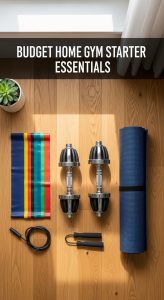
budget home gym starter pack essentials
The Essential Equipment You Actually Need
Let’s cut through the marketing noise and focus on what genuinely matters. Your starter pack should include five core categories that cover strength, cardio, flexibility, and recovery.
1. Adjustable Dumbbells: Your Versatile Foundation
Adjustable dumbbells are the MVP of budget home gyms. These space-saving powerhouses replace an entire rack of weights while costing a fraction of the price.
Quality adjustable sets range from 5 to 50 pounds per dumbbell. This range covers everything from bicep curls to goblet squats, making them perfect for beginners and intermediate lifters.
Look for models with secure locking mechanisms—nothing kills a workout faster than weights shifting mid-rep. The quick-adjustment dial systems save time between exercises.
You can perform over 50 different exercises with dumbbells alone. Chest presses, shoulder raises, lunges, rows, and even core work become possible with this single investment.
Check out the latest adjustable dumbbell options at Gym Equipage for competitive pricing and verified customer reviews.
2. Resistance Bands: The Underrated Game Changer
Don’t underestimate resistance bands—they’re scientifically proven to build muscle just as effectively as free weights. Research shows that tension-based training activates muscle fibers differently than gravity-based weights.
A complete band set costs between $15 and $40 depending on quality and quantity. You’ll want at least three resistance levels: light, medium, and heavy for different muscle groups and progression.
Resistance bands excel at:
- Shoulder and rotator cuff exercises
- Glute activation and leg work
- Assisted pull-ups and stretching
- Travel workouts (they fit in any suitcase)
- Rehabilitation and injury prevention
The continuous tension throughout each movement creates a unique muscle stimulus. Unlike dumbbells where gravity provides resistance in only one direction, bands challenge your muscles through the entire range of motion.
3. Exercise Mat: Protection and Comfort
A quality exercise mat is non-negotiable for floor work, stretching, and bodyweight exercises. Cheap mats compress quickly and offer zero joint protection.
Invest in a mat that’s at least 6mm thick for adequate cushioning. Premium options reach 10mm or more, which feels amazing during planks, push-ups, and ab work.
Non-slip surfaces matter tremendously. You need grip on both sides—one to stick to your floor, the other to prevent your hands and feet from sliding during downward dog or mountain climbers.
Proper dimensions are important too. Standard 24″ x 68″ mats work for most people, but taller individuals should consider extended lengths for full-body movements.
Explore premium exercise mats designed for home use that balance comfort with durability.
budget home gym starter pack essentials
4. Jump Rope: Maximum Cardio, Minimum Investment
Jump rope training burns approximately 10-16 calories per minute—that’s more than most cardio machines costing thousands of dollars. A quality jump rope costs less than $20.
This simple tool delivers incredible cardiovascular benefits. Ten minutes of jumping rope equals roughly 30 minutes of jogging in terms of calorie burn and cardiovascular conditioning.
Modern jump ropes feature weighted handles for upper body engagement and adjustable lengths for different heights. Ball-bearing systems create smooth rotations for speed work and double-unders.
Jumping rope improves:
- Coordination and footwork
- Bone density (weight-bearing exercise)
- Cardiovascular endurance
- Caloric expenditure
- Mental focus and rhythm
You can integrate jump rope intervals between strength exercises for efficient full-body workouts. This approach keeps your heart rate elevated while allowing muscle groups to recover.
5. Pull-Up Bar or Suspension Trainer
Upper body pulling movements are essential for balanced muscle development and posture correction. Most people have plenty of pushing exercises but neglect their back muscles.
Doorway pull-up bars install in minutes without drilling and cost $25-$50 for quality options. They support multiple grip positions for targeting different back and arm muscles.
Suspension trainers offer incredible exercise variety using your bodyweight as resistance. These systems anchor to doors, beams, or outdoor structures for hundreds of movement patterns.
Can’t do a pull-up yet? No problem. Resistance bands loop over the bar to provide assistance while you build strength progressively.
Find pull-up bars and suspension training systems that fit standard door frames securely.
Complete Budget Breakdown: What to Spend
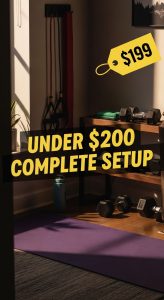
Let’s talk real numbers for setting up a functional home gym under $200. This budget gets you quality equipment that lasts years with proper care.
Essential Equipment Investment:
- Adjustable dumbbells (5-50 lbs): $80-$120
- Resistance band set (5 bands): $20-$35
- Premium exercise mat (10mm): $30-$50
- Weighted jump rope: $15-$25
- Doorway pull-up bar: $25-$40
Total investment: $170-$270 depending on brand choices and sales. Compare this to a single year of gym membership and you’re already ahead financially.
Optional additions under $50 each:
- Foam roller for recovery
- Stability ball for core work
- Ankle weights for leg exercises
- Workout timer or stopwatch
- Storage rack or bins
Setting Up Your Space for Success
Dedicated workout space dramatically increases exercise consistency. Even a 6×6 foot area transforms into an effective training zone with smart organization.
Choose a spot with adequate ceiling height for overhead movements. Standard 8-foot ceilings work fine unless you’re exceptionally tall or doing Olympic lifts (which you’re not on a budget setup).
Natural lighting boosts mood and energy during workouts. Position your space near windows when possible, but avoid direct sunlight on screens if you’re following video workouts.
Flooring considerations matter more than you’d think. Rubber mats or interlocking foam tiles protect both your floor and your equipment from impact damage.
Ventilation keeps you comfortable during intense sessions. A simple fan costs $20-$40 and makes a noticeable difference in workout quality and recovery.
Browse home gym organization solutions that maximize small spaces efficiently.
Workout Programming for Beginners
Having equipment means nothing without a solid plan. Your first month should focus on learning proper form and building the exercise habit consistently.
Start with three 30-minute sessions per week. This frequency allows adequate recovery while establishing routine momentum without overwhelming your schedule.
Sample beginner structure:
- 5 minutes: Dynamic warm-up and joint mobility
- 20 minutes: Strength circuit (3-4 exercises, 3 rounds)
- 5 minutes: Cardio intervals (jump rope or bodyweight)
- 5 minutes: Cool-down stretching
Focus on compound movements that work multiple muscle groups simultaneously. Squats, push-ups, rows, and lunges deliver maximum results from minimum time investment.
Progressive overload drives adaptation and results. Add one rep, one set, or slightly more resistance each week to continually challenge your muscles.
Avoiding Common Beginner Mistakes
Buying equipment before defining your goals leads to wasted money on unnecessary items. Determine whether you prioritize strength, cardio, flexibility, or general fitness first.
Many newcomers purchase too much too fast. Start minimal and add pieces as you identify actual needs through consistent training experience.
Ignoring proper form to lift heavier weights creates injury risk and reduces exercise effectiveness. Learn perfect technique with lighter resistance before progressing.
Skipping warm-ups seems like time-saving but actually increases injury likelihood. Five minutes of movement preparation protects your joints and enhances performance.
Inconsistency kills progress faster than imperfect programming. Showing up regularly with decent effort beats perfect workouts done sporadically every single time.
Maximizing Your Equipment Investment
Every piece of equipment should serve multiple functions. This principle stretches your budget while keeping your workout space uncluttered.
Dumbbells work for both isolation exercises and full-body movements. Use them for traditional curls and presses, but also for farmer’s carries, renegade rows, and loaded squats.
Resistance bands attach to door anchors to create cable machine alternatives. This simple addition unlocks chest flies, tricep pushdowns, and lat pulldowns at home.
Your exercise mat becomes a stretching station, meditation space, and comfortable surface for bodyweight core work. Yoga, Pilates, and mobility routines all happen here.
Jump ropes aren’t just cardio tools—they’re also timing devices for interval training and coordination development for athletic performance.
Discover multi-functional fitness equipment designed for versatile home training.
Recovery Tools That Matter
Muscle growth happens during recovery, not during workouts. Budget-friendly recovery tools accelerate your progress and reduce soreness significantly.
Foam rollers cost $15-$40 and provide self-myofascial release similar to professional massage. Rolling tight muscles improves blood flow and range of motion noticeably.
Lacrosse balls or massage balls target specific trigger points that foam rollers can’t reach effectively. Your feet, shoulders, and hips especially benefit from targeted pressure.
Adequate sleep remains the most important recovery tool—and it’s completely free. Aim for 7-9 hours nightly to optimize hormone production and tissue repair.
Hydration and nutrition matter tremendously for recovery. Drink at least half your bodyweight in ounces of water daily and prioritize protein intake around workouts.
Tracking Progress Without Expensive Tech
You don’t need fancy fitness trackers to monitor improvement and stay motivated. Simple metrics reveal progress clearly when tracked consistently.
Keep a basic workout journal noting exercises, weights, reps, and sets. Reviewing this data weekly shows strength gains that might not feel obvious day-to-day.
Take monthly progress photos in consistent lighting and poses. Visual changes often appear before scale numbers move, especially when building muscle while losing fat.
Measurement tracking includes:
- Body measurements (chest, waist, hips, thighs, arms)
- Performance benchmarks (max push-ups, plank duration)
- Energy levels and sleep quality
- How clothes fit differently
Free smartphone apps handle workout logging and timer functions. You already own the technology—no additional purchase necessary for effective tracking.
Building Your Gym Over Time
Start with the absolute essentials and expand your equipment collection as your fitness level advances and specific needs emerge.
Month one focuses on dumbbells, bands, and a mat. This combination covers 90% of beginner training needs while keeping initial investment minimal.
Add cardio equipment around month three once strength training habits solidify. Jump ropes offer the best value, but consider kettlebells for dynamic movements too.
Recovery tools make sense after 6-8 weeks of consistent training when you’re working hard enough to need serious muscle care and maintenance.
Specialty items like stability balls, medicine balls, or suspension trainers join your arsenal as you identify exercise gaps. Let your actual training experience guide purchases rather than marketing hype.
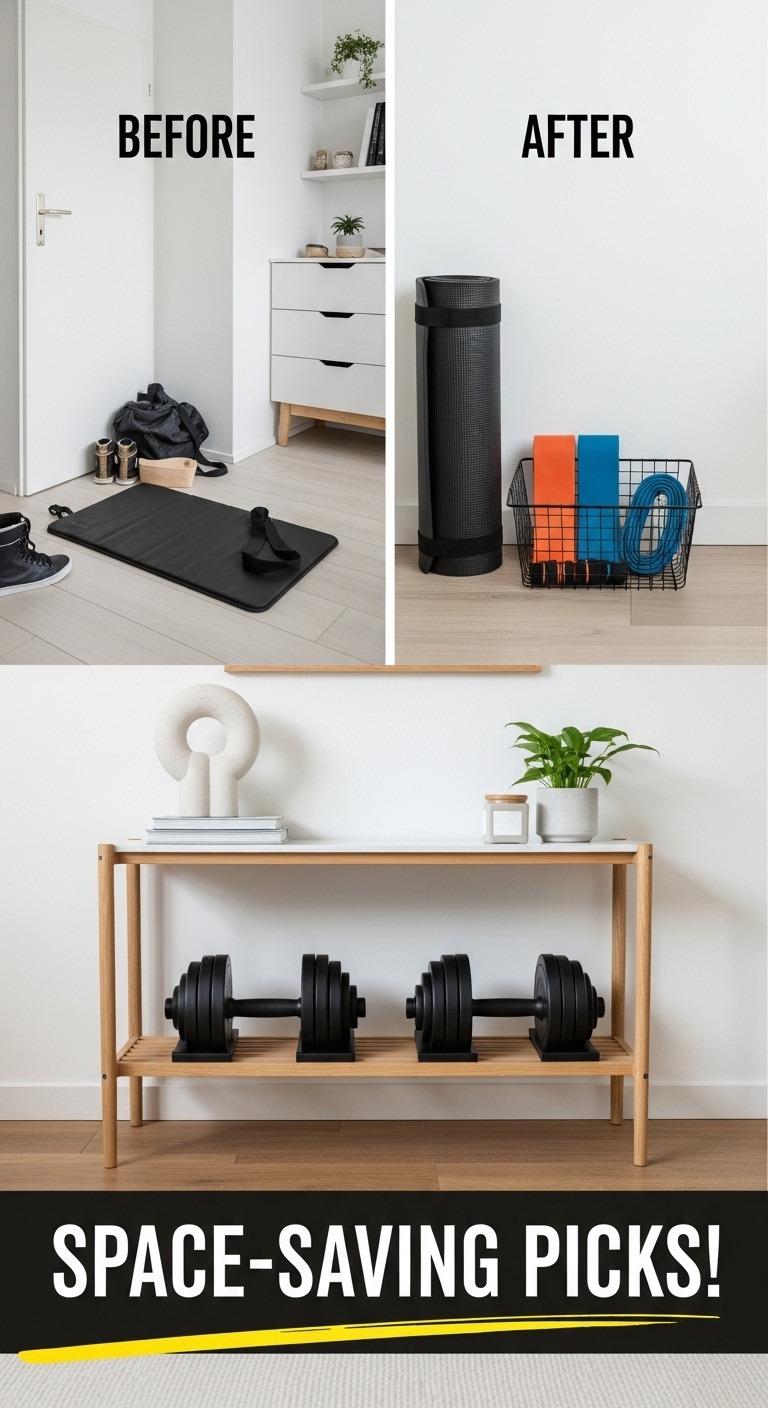
Space-Saving Storage Solutions
Organized equipment encourages consistent use while cluttered chaos creates mental resistance to working out at home.
Wall-mounted storage systems keep dumbbells off the floor and easily accessible. Vertical storage maximizes limited floor space in apartments and small homes.
Hanging organizers work perfectly for resistance bands, jump ropes, and small accessories. Behind-door hooks cost under $10 and utilize otherwise wasted space.
Rolling storage carts allow you to wheel your entire gym into a closet after workouts. This approach keeps living spaces multipurpose without permanent equipment visibility.
Clear bins with labels help you find accessories quickly. Five minutes of organization weekly prevents the equipment chaos that derails workout momentum.
Conclusion
Budget home gym starter pack essentials prove that effective fitness doesn’t require financial stress or expensive memberships. With strategic equipment choices under $200, you’re fully equipped for transformative results.
Your investment in adjustable dumbbells, resistance bands, a quality mat, jump rope, and pull-up bar covers every training angle. These versatile pieces support strength building, cardiovascular conditioning, flexibility work, and progressive overload for years.
Consistency with simple equipment beats sporadic access to fancy facilities. The convenience of home training eliminates common excuses while saving money, time, and commuting hassle.
Start minimal, focus on proper form, and add equipment as your experience reveals genuine needs. Your budget home gym starter pack essentials journey begins with a single workout—schedule it now.
Frequently Asked Questions
Q: Can I really build muscle with just budget home gym equipment?
A: Absolutely. Muscle growth requires progressive resistance and proper nutrition—not expensive equipment. Adjustable dumbbells and resistance bands provide sufficient stimulus for significant muscle development when used consistently with good programming.
Q: How much space do I need for a home gym?
A: A functional home gym fits comfortably in a 6×6 foot area (36 square feet). This accommodates your exercise mat with room for movement. You can train effectively in even smaller spaces using foldable equipment and vertical storage solutions.
Q: What’s the most important piece of equipment to buy first?
A: Adjustable dumbbells deliver the most training versatility for your initial investment. They enable dozens of exercises targeting all major muscle groups and support progressive overload as you get stronger over time.
Q: How long does budget gym equipment last?
A: Quality budget equipment lasts 5-10 years with proper care and maintenance. Resistance bands wear faster (2-3 years with heavy use), but they’re inexpensive to replace. Dumbbells and bars often last decades when stored properly.
Q: Do I need a bench for home workouts?
A: While benches add exercise options, they’re not essential for beginners. You can perform floor presses, use a stability ball as a bench alternative, or do incline work against a wall. Add a bench after mastering bodyweight and standing movements.
Q: Can budget equipment replace a full gym membership?
A: For 80-90% of fitness goals, yes. Budget home setups excel at strength training, cardio, and flexibility work. Serious powerlifters or those who need specific machines might still benefit from occasional gym access for specialized equipment.
Q: What exercises can I do with minimal equipment?
A: Hundreds of effective movements work with basic equipment. Dumbbells enable presses, rows, curls, and loaded squats. Bands provide resistance for nearly every muscle group. Bodyweight exercises like push-ups, squats, and planks require zero equipment.
Q: How do I stay motivated working out at home?
A: Create dedicated workout space, schedule specific training times, track progress visually, follow structured programs, and consider online workout communities for accountability. Having equipment ready and visible reduces friction to starting each session.